Kahal Kadosh Beth Elohim (KKBE) celebrates 275 years since its establishment in Charleston, South Carolina

Read More

The congregation of Kahal Kadosh Beth Elohim was founded in 1794 on the peninsula of Charleston, South Carolina. 275 years later, it stands as a symbol for strength, perseverance, tradition and heritage for the Jewish and entire Charleston community. Let’s take a look back at its deeply rooted history.

History of Kahal Kadosh Beth Elohim

The history of Kahal Kadosh Beth Elohim (90 Hasell Street, Charleston, SC) is a heritage in which all American Jews can take pride. It is a story of faith, devotion, and perseverance in the American tradition of freedom
of worship. 

Charleston was founded in 1670, and the earliest known reference to a Jew in the English settlement is a description dated 1695. Soon thereafter other Jews followed, attracted by the civil and religious liberty of South Carolina and the ample economic opportunity of the colony. These pioneers were sufficiently numerous by 1749 to organize the present congregation, Kahal Kadosh Beth Elohim, (Holy Congregation House of God) and, fifteen years later, to establish the now historic Coming Street Cemetery, the oldest surviving Jewish burial ground in the South. 

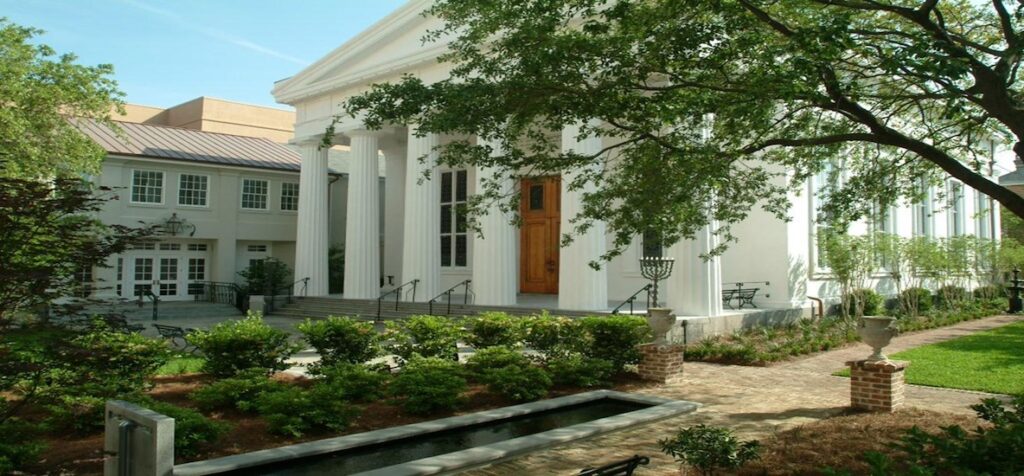
KKBE is the fourth oldest Jewish congregation in the continental United States (after New York, Newport and Savannah). At first, prayers were recited in private quarters and from 1775, in an improvised synagogue adjacent to the present-day grounds. In 1792, construction of the largest and most impressive synagogue in the United States was commenced. It was dedicated two years later. A member of the visiting Lafayette’s entourage is reported to have described the building as “spacious and elegant.” This handsome, cupolated Georgian synagogue was destroyed in the great Charleston fire of 1838 and replaced in 1840 on the same Hasell Street site by the structure in use today. The colonnaded building, dedicated in early 1841 is often described as one of the country’s finest examples of Greek Revival architecture. On this occasion, KKBE’s Reverend Gustavus Poznanski was moved to say, “This synagogue is our Temple, this city our Jerusalem, and this happy land our Palestine.” 

Today, KKBE has the second oldest synagogue building In the United States and the oldest in continuous use. It was designated a National Historic Landmark in 1980. 
Birthplace of Reform 

Charleston is acknowledged as the birthplace of Reform Judaism in the United States. In 1824, 47 congregants petitioned the Adjunta (the trustees) of the synagogue to change the Sephardic Orthodox liturgy. The petition, which asked for abridgement of the Hebrew ritual, English translation of the prayers, and a sermon in English, was denied. The disappointed liberal members thereupon resigned from the congregation and organized “The Reformed Society of Israelites”. This independent society, led by Isaac Harby and Abraham Moise was influenced by the ideas of the Hamburg Reform congregation, the leading modernist community in Europe. It lasted only nine years, but many of its practices and principles have become part of today’s Reform Judaism The Progressives rejoined the old congregation, and while the present temple was being built in 1840, an organ was installed. As well as the organ, the first service in the new temple introduced a liberalized ritual. KKBE was one of the founding synagogues of the Union of American Hebrew Congregations in1873, (now Union for Reform Judaism, URJ), and remains firmly and proudly committed to Reform Judaism. 

Leadership 

For almost two and a half centuries members of KKBE have been eminent leaders in the city, state and country. Among notable early congregants were Moses Lindo, who before the Revolution helped to develop the cultivation of Indigo (then South Carolina’s second crop) and Joseph Levy, veteran of the Cherokee War of 1760-61 and probably the first Jewish military officer in America. Almost two dozen men of Beth Elohim served in the War of Independence, among them the brilliant young Francis Salvador, who as delegate to the South Carolina Provincial Congresses of 1775 and 1776, was the first Jew to serve in an American legislature. Killed shortly after the signing of the Declaration of Independence, Salvador was also the first Jew known to die in the Revolutionary War. 
Members of the congregation founded Charleston’s Hebrew Benevolent Society in 1784, the nation’s oldest Jewish charitable organization, and in 1801 established the Hebrew Orphan Society, also the country’s oldest. Both are still active. In 1838 the second oldest Jewish Sunday school in the United States was organized, The blind poet, Penina Moise, was a famous early superintendent. 

Other congregants pioneered in steamship navigation, introduced illuminating gas to American cities, and numbered four of the eleven founders of the country’s Supreme Council of Scottish Rite Masonry. 

In 1790, President George Washington responded to a letter of congratulations to him by writing, “The affectionate expressions of your address again excite my gratitude, and receive my warmest acknowledgment. May the same temporal and eternal blessing which you implore for me, rest upon your Congregation.” A replica of this letter can be viewed in the KKBE Museum.

The Synagogue

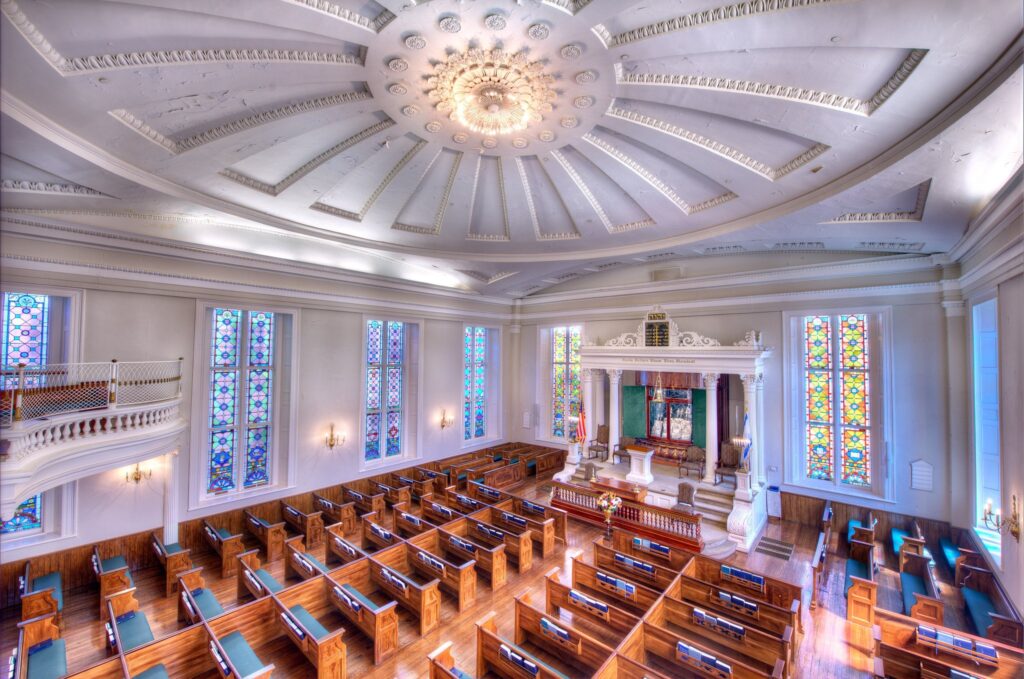
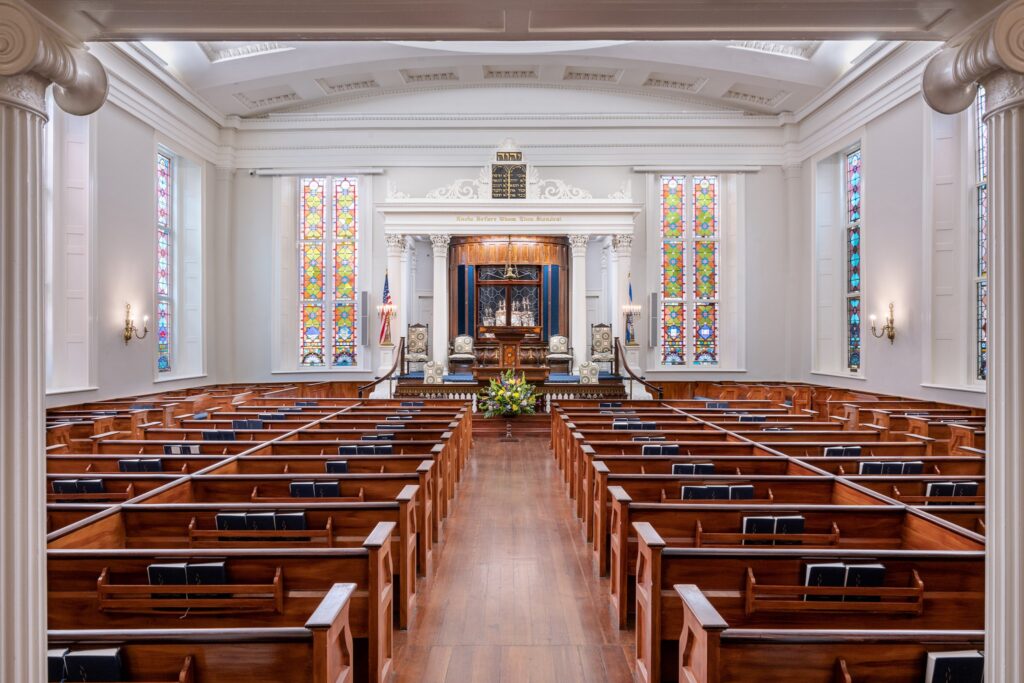
This outstanding Greek Revival style building was constructed in 1840 by member David Lopez from a design by architects Tappan and Noble and work plans by C. L.Warner. It replaces a 1794 cupolated Georgian style structure destroyed by fire in 1838. The temple grounds are fronted by a graceful iron fence dating from the 1794 synagogue. Also surviving are the bases of two menorahs (candelabras) on either side of the Bimah. The large marble tablet above the huge entrance doors proclaims the Sh’ma in Hebrew and an unusual English translation: “Hear O Israel the Lord Our God is the sole Eternal Being.” In the foyer over the entrance to the sanctuary is the original dedication stone from the 1794 synagogue. When our current building was erected in 1840, a controversial organ was installed in the balcony at the rear of the sanctuary. Housing our four Torah scrolls is the massive ark made of Santo Domingo mahogany. The stained glass windows, which show Jewish religious symbols, date from 1886 and are replacements of windows destroyed in the earthquake of that year. The interior of the synagogue, originally following a traditional Sephardic Orthodox arrangement, was altered first in 1879 with the installation of family pews and the removal of the pulpit to the front of the sanctuary. Then, in 1886, after the earthquake, balconies on both sides of the building were removed and the Bimah reconfigured. 

In 2003, the Congregation received the prestigious Carolopolis Award for exterior preservation. 
Pearlstine Family Building 

Parallel to the length of the Temple stands the building formerly called the Bicentennial Tabernacle, which was erected in 1950 during the 200th anniversary celebration of the congregation. This building replaced the temporary structure built after the 1838 fire. The Tabernacle was renovated and expanded in 2001-03 and renamed the Pearlstine Family building. The current building houses the religious school, our administrative office, the Chosen Treasures Judaica & Gift Shop, the spacious Barbara Pearlstine Social Hall and the kitchen. The original cornerstones are located over the entranceway into Barbara Pearlstine Hall. In the Social Hall two large murals painted by Charleston artist William Halsey, a former congregant, portray founders and patriots of the congregation.There are also a pair of wrought iron sculptures of Biblical prophets by the late Willard Hirsch. 

The Heyman Building 

The reconditioned and expanded 18th century residence to the rear of the Temple at 86 Hasell Street contains a youth lounge and supplemental meeting and classrooms. 

Our Cemeteries

Coming Street Cemetery KKBE’s Coming Street Cemetery (190-195 Coming Street) is the oldest surviving Jewish cemetery in the South. It is listed on the National Register of Historic Places.

Buried here are:

  • Ten congregants who fought in the American Revolution,
  • Six soldiers of the War of 1812,
  • Two soldiers in the Seminole Wars in Florida,
  • 21 Civil War participants, of whom eight died in the Confederate cause,
  • Six Rabbis of the congregation,
  • 18 Past presidents of the congregation.
  • Four of the eleven founders of the Supreme Council of Scottish Rite Masonry in 1801.

Bronze plaques placed on some tombstones in 1964 identify notable personages. Except for a few family plots, all present day burials occur in Beth Elohim’s Huguenin Avenue Cemetery, which was established in 1887. When this site was first used as a cemetery, it was outside the then city limits at Calhoun Street.

The Coming Street Cemetery has three sections:
A. This area is the original congregational cemetery and dates from 1764; from 1754; it was the DaCosta family plot. 
B. This part was developed by members of Beth Elohim who had seceded in 1841 over the installation of an organ in the synagogue and had formed Orthodox Congregation Shearit Israel. When the two congregations merged after the Civil War, a dividing wall was taken down. 
C. The Lopez family plot was established in the 1843 when Shearit Israel refused burial to David Lopez’s first wife who had not been converted to Judaism. The Cemetery contains over 500 graves; many are not marked. The oldest identifiable grave is that of Moses D. Cohen, the first religious leader of Beth Elohim, who died in 1762.

Visitation to the Coming Street Cemetery must be made by appointment. Call 843-723-1090. To see index of cemetery burials click here.

Huguenin Avenue Cemetery K.K.B.E.’s Huguenin Avenue Cemetery is its present burial ground. It was first developed on land, which then abutted the northern limit of the City of Charleston. It was purchased from the Washington Light Infantry in l887.

The cemetery was expanded in l991 on property bought from the Standard Oil Company in 1943. It contains the remains of persons buried since l888, also remains and stones which were removed from three defunct graveyards: the Dacosta (l783-l939) and Harby (1799-1939) cemeteries on Hanover Street, and the Rikersville Cemetery (1857-1888), which had been established by Congregation Shearit Israel).

To see a list of the burials in the Huguenin Avenue Cemetery click here.

To see a list of the burials in the Coming Street Cemetery click here.

On July 1, 2010, Rabbi Stephanie Alexander became the first woman Rabbi of Kahal Kadosh Beth Elohim. At the same time, Rabbi Anthony D. Holz, retired and became Rabbi Emeritus.

Click here to watch a video on KKBE’s history, narrated by volunteer docent T.R. Williams.

Source: History acquired from KKBE website – kkbe.org

Additional Resources

Roseline, a Neighborhood Wine Bar Set to Open in Elliotborough Neighborhood of downtown Charleston, SC on November 8, 2024

Read More

By Mark A. Leon

November 8, 2024 marks the grand opening of a new neighborhood bar, Roseline to be located at 125 1/2 Line St, Charleston, SC 29403 (Old Sightsee Coffee spot).

What is Roseline?

Roseline is a funky neighborhood hangout located in downtown Charleston. “Roseline” is more than just the name of the bar. It is its location – on the corner of Rose and Line Street. It is a place for the community to gather, lounge and socialize. Offering a selection of beer and wine and other beverages, our intimate space is just 429 square feet. Our mission is simply “keep Charleston small,” like Roseline itself.

Stay connected with Roseline on Instagram.

Official Website

Stay connected on local happenings and subscribe to Charleston Daily.

New Retail Shop to Open on Small Business Saturday in Park Circle – Grand Opening of Neighborly on November 30, 2024

Read More

Neighborly brings vintage and modern decor, home goods, and design services to North Charleston’s vibrant Park Circle neighborhood 

——— 

  • Lowcountry Local First cofounder Jamee Haley opens decor and design destination on Small Business Saturday
  • Neighborly brings local, regional, and global goods to vibrant North Charleston business district
  • Charleston-based J. Stark moving operations to Park Circle, sharing space with new retail shop

North Charleston, SC, October 31, 2024 – Neighborly, a new retail destination offering a thoughtfully curated mix of local, regional, and global goods, will officially open its doors in the heart of Park Circle on Small Business Saturday, November 30, 2024. 

Neighborly will offer a unique selection of both new and vintage furniture, household goods, and gift items, designed to bring beauty and function into any home at various price points. The shop will also be home to Hue Interiors, adding an additional layer of design services, pop-up events, and workshops.

Conceived by Owner and Chief Curator Jamee Haley, Neighborly is not just a shop but a reflection of her dedication to supporting local business, travel, and design. “Neighborly feels like the culmination of what I have been working on and taking joy in for the past 16 years, supporting local businesses, travel, and design, and Park Circle is my neighborhood,” Haley shares. “As the co-founder of Lowcountry Local First, I had the pleasure of meeting so many talented local business owners. Since stepping down in 2021, I’ve had the opportunity to travel and source items that are both unique to specific regions and beautifully crafted. I truly hope it’s a place where everyone will find a little something that they love.”

Neighborly will carry a range of hand-selected items from beloved Charleston brands like J. StarkSmithey IronwareSusan Gregory PotteryHeart of Gold, and BR Design Co, alongside artisanal finds from Haley’s travels, such as organic handwoven blankets from Portugal. The space aims to become a gathering place for locals to explore unique products and participate in workshops and community events.

Sharing the Neighborly space is J. Stark, an established Charleston-based brand moving operations from Upper King Street to Park Circle. “Having navigated the changing landscape of Upper King Street for five years, the time has come for a J. Stark move back to a spot with more of a neighborhood vibe,” says Jess Nicoles, owner of J. Stark. “We’ve missed our local friends during our time in the bustle and are thrilled to bring our work to Park Circle. We’re excited to share this space with Jamee and our new neighbors.”

Shop Details and Grand Opening Specials
Neighborly is located at 1042 East Montague Avenue.Shop doors will open to the public on November 30, with regular hours Wednesday through Sunday from 11:00 AM to 6:00 PM. Customers can look forward to seasonal pop-up events, exclusive workshops, and other community-centered activities.

The property is managed by Cityvolve.

Keep up with Neighborly’s latest on Instagram (@neighborlypc) or visit their website at www.neighborlypc.com.

Spoleto Festival USA Announces Seven New Board Members

Read More

October 30, 2024 (Charleston, SC) Spoleto Festival USA, America’s premier performing arts festival, is pleased to announce the election of seven new members to its board of directors. Joining the board are Julie Caperton, Sam Easley, Michael Hostetler, Susan S. Keenan, Eddie Robinson, Michael Seekings, and Diana Vesga. 

The board of directors of Spoleto Festival USA is a group of dedicated individuals from across the country, united by a shared passion for the performing arts. With diverse backgrounds and a range of skills, Spoleto board members are responsible for overseeing the organization’s strategic direction and financial health.  

“I am excited to work alongside our new board members to build upon our organization’s success,” says Mena Mark Hanna, general director and CEO of Spoleto Festival USA. “Their unique perspectives and collaborative spirit will strengthen our team and drive us forward.” 

Spoleto Festival USA Board Chair Phil Smith says “our new board members bring a wealth of experience and a shared commitment to making a positive impact. I am confident that their contributions will help us achieve our goals and create a brighter future.” 

Mrs. Julie Caperton, board member, is the head of The Private Bank and Wells Fargo Partnerships. Since joining Wells Fargo in 2002, Julie has held several leadership positions including leading corporate development. She also served as the head of asset-backed finance and corporate trust services and as the head of structured products in the legal division. Julie is involved in fundraising for educational, arts, and medical research organizations. She serves on the board of visitors of Wake Forest Law School and on the board of directors for Asian & Pacific Islander American Scholars. Julie, an avid runner and traveler, lives in Cornelius, North Carolina, with her husband, two children, and two dogs. 

Mr. Sam Easley, board member, is the founder and CEO of Crown Merchandise, a full-service merchandising company that represents a wide range of brands on tour, at retail, and through strategic licensing partnerships. Sam enjoys studying Southern culture and literature, specifically focused on the notable authors from his home state of Mississippi. His passion for cultural preservation has in part involved historic restorations, including multiple properties listed on the National Register of Historic Places. Sam resides in Charleston with his husband and three children. 

Dr. Michael Hostetler, board member, is a partner at the law firm Wilson Sonsini. His expertise includes patent strategy, patent prosecution, and patent diligence for venture financings, public offerings, and mergers and acquisitions. He has provided patent counseling in support of pharmaceutical and biotechnology products in all stages of development, from proof of concept to regulatory approval to product launch. Mike is the founder of Phenotypic Recordings, LLC, a record label that focuses on bringing new music to light. He and his wife reside in San Francisco, California, and are ardent supporters of the arts. 

Mrs. Susan S. Keenan, board member, has over 23 years of experience in the nonprofit sector. Susan has served as a consultant with Corporate DevelopMint, LLC, before becoming executive director at Roper St. Francis. Sue was also director of institutional advancement at Hammond School before consulting with Change Development Move where she continues to enjoy working with nonprofits. In addition to volunteering with various organizations, Sue and her husband Neel split time between Columbia and Charleston, South Carolina, and visiting their five sons across the country. 

Dr. Eddie Robinson, DVM, board member, is a retired veterinarian who practiced for over 32 years. He is a member of the South Carolina Association of Veterinarians, and the Greater Columbia Association of Veterinarians. Eddie is the founder and principal of Rand-Roo Enterprises and Rand-Roo Estate Holdings. Eddie serves on the South Carolina Athletic Hall of Fame board of directors and Clemson University IPTAY board of directors. He is an adjunct instructor at Midlands Technical College. Eddie lives in Columbia, South Carolina, and in his free time he enjoys spending time with family and listening to jazz. 

Mr. Michael Seekings, board member, is serving a fourth term as Charleston City Councilman representing district 8. He is chairman of CARTA, chairman of the Traffic and Transportation Committee, vice chairman of the Ways and Means Committee, a member of the Public Safety Committee, a member of the Public Works and Utilities Committee, and chairman of the Audit Committee. Mike serves on the board of the Charleston Area Convention and Visitors Bureau and the Gibbes Museum of Art. He is an adjunct professor at the College of Charleston and former adjunct professor at the Charleston School of Law.  

Ms. Diana Vesga, board member, is the COO at LACMA, the largest art museum in the western U.S., and previously served as their chief administrative officer. Diana served on the County of Los Angeles Advisory Committee for Cultural Diversity and Equity since 2015 and was recognized in 2023 on the floor of the US Congress on Women’s History Month. Previously, Diana was vice president of private equity at Oaktree Capital, and vice president of investor relations and corporate finance at Univision Communications. Diana was a soprano in Grupo Ballestrinque, the prominent Colombian chamber choir, with whom she performed at the Vatican. She lives in Pasadena, California, with her husband and two sons. 

For more information about Spoleto Festival USA, visit spoletousa.org

### 

SPOLETO FESTIVAL USA

Spoleto Festival USA was founded in 1977 by Pulitzer Prize-winning composer Gian Carlo Menotti, who sought to create an American counterpart to the annual Festival of Two Worlds in Spoleto, Italy, which he had founded in 1958. Now in its 48th year, Spoleto Festival USA is internationally recognized as America’s premier performing arts festival. For 17 days and nights each spring, Spoleto Festival USA fills Charleston’s historic theaters, churches, and outdoor spaces with performances in opera; theater; dance; and chamber, symphonic, choral, and jazz music. Spoleto’s mission is to present programs of the highest artistic caliber while maintaining a dedication to young artists, a commitment to all forms of the performing arts, a passion for contemporary innovation, and an enthusiasm for providing unique performance opportunities for established artists. Beyond its role as a launching pad for young talent, Spoleto also serves as a catalyst for cultural change and has aided in Charleston’s flourishing as a top arts and culture destination. With General Director & CEO Mena Mark Hanna at its helm, the 2025 season takes place from May 23 to June 8 in various locations throughout Charleston. Spoleto Festival USA is a 501 (c)(3) charitable organization.  

MUSC Health Breaks Ground on New Clements Ferry Pavilion Location – Here is what you need to know

Read More

The Cainhoy community on the Cainhoy Peninsula in Charleston, South Carolina, is experiencing rapid population growth, with significant increases expected in the coming years. This growth necessitates expanded health care services to meet the needs of new and existing residents. 

The community is home to a blend of long-time residents and newcomers, including families, professionals, retirees, and students.

There is a need for more specialty care, as many residents currently must travel significant distances to access these services, which can be a barrier to receiving timely and effective care.

Coming Soon

The MUSC Health Clements Ferry Pavilion, a four-story, 80,000-square-foot medical office building slated to open in late 2025, will provide high-quality, accessible health care to the growing community with nearly a dozen specialties.

Community Benefits

  • Convenient access to a range of medical services, including primary care, specialty care, and advanced imaging – all in one location.
  • Essential maternal and child health services, supporting families with prenatal care, pediatric care, and other family health needs.

Clinical Services Offered

The Clements Ferry Pavilion will offer a range of medical services across nearly a dozen specialties. These services include:

  • Adult and pediatric primary care
  • Advanced imaging center
  • Gastroenterology 
  • Heart & vascular care
  • Multispecialty clinic (including surgery, rheumatology, endocrinology, neurology, and neurosurgery)
  • Obstetrics & gynecology
  • Oncology and infusion services
  • Ophthalmology
  • Orthopedics
  • Physical and occupational therapies

Location: 1101 Waterline Street, Charleston, SC 29492

Source link: MUSC Health

Students Striving to End Homelessness in Charleston, SC and Beyond – Are you ready to make a difference?

Read More

By Mark A. Leon

Students Striving to End Homelessness is a 6-8 week community-wide engagement project led by One80 Place with the goal of preventing homelessness. They can use your support!

Click HERE to complete an interest application.

About Students Striving to End Homelessness

Students Striving To End Homelessness is a dynamic leadership and community engagement program designed for high school students. Over a 6-8 week period, students will actively advocate for One80 Place and support its mission to end and prevent homelessness.

Through this program, participants will develop leadership skills, engage in meaningful community service, and gain a deeper understanding of homelessness and its impact. This experience empowers students to become informed advocates and leaders in their communities, committed to making a lasting difference.

Why Participate?

Black Food Truck Festival Delivers Massive Economic Impact to Charleston Region of $10.2M

Read More

CHARLESTON, S.C. – The 2024 Black Food Truck Festival, held April 26-28 at the Exchange Park Fairgrounds in Ladson, South Carolina, proved to be a resounding economic success for the Charleston Tri-County area. The event, which featured over 40 Black-owned food trucks and vendors, attracted more than 13,100 attendees and generated an estimated $10.20 million in total economic impact.

With 83% of ticket holders coming from outside the region, the festival significantly boosted local tourism. The three-day event supported 79 full-time equivalent jobs and generated $1.66 million in tax revenue.

“We are thrilled with the overwhelming success of the Black Food Truck Festival,” said Marcus Hammond, Founder, Black Food Truck Festival. “This event showcased the incredible talent and entrepreneurship of business owners in our region while simultaneously providing a significant economic boost to our local economy!”

The festival’s economic impact can be attributed to increased spending on food, beverages, lodging, transportation, and other goods and services. The event also helped to raise awareness of Black-owned businesses and the importance of supporting local entrepreneurs.

The Office of Tourism Analysis (OTA) at the College of Charleston conducted this economic impact report to assess the economic benefits of the Black Food Truck Festival in the Charleston region.

The 2024 Black Food Truck Festival was a major success, and organizers are already planning for next year’s event. For more information about the Black Food Truck Festival please visit blackfoodtruckfestival.com or follow on social media at @blackfoodtruckfestival.

 Watch the 2024 Black Food Truck Festival Recap video

Stay connected and subscribe to Charleston Daily.

Update: SOLD: 5 East Battery is on the market in downtown Charleston for $22.25M (Yes the giant Pink House)

Read More


Update: The property sold this week for $18,250,000

Pink on the Coast: Now you can own this newly renovated 8 bedroom, 10 baths, 9,407 Square Feet dream house at 5 E Battery in historic downtown Charleston, South Carolina. Even Barbie is a little envious.

All yours for $22,250,000.

Click HERE for complete listing.

About the Home

Located on High Battery, with sweeping and uninterrupted views of Charleston Harbor and Fort Sumter, sits one of the grandest homes in the city, the John Ravenel House. This historic residence, circa 1848, is one of Charleston’s most recognized homes and was recently reimagined during a multi-year renovation. Rebuilt after the 1886 earthquake, the stuccoed brick home showcases stunning Italianate entablature and lintels, creating an instantly recognizable facade. Inside, the spacious, three-story home retains beautifully preserved details including period fixtures, original mantles, hardwood floors, restored moldings and door surrounds, and ceiling medallions that are historically inspired re-creations.Large formal rooms and generous bedroom suites create an inviting layout for everyday living and unparalleled entertaining.

The private walled grounds are equally spectacular, featuring formal gardens designed by Perry Guillot who revamped the Rose Garden at the White House, a private pool and spa, and lush landscaping that creates an oasis of beauty and privacy. A detached three-bedroom carriage house complements the mother-in-law/staff/guest wing in the main home, affording ample room for family and friends. The meticulous multi-year renovation was led by renowned industry professionals, including Richard “Moby” Marks (builder), Glenn Keyes (architect), Richard Keith Langham (decorator), and Perry Guillot (landscape architect).

This conglomeration of talent resulted in the extraordinary in-town compound. The meticulousness is matched only by the artistry that went into the re-creation. The foyer features an intricate custom patterned floor designed by local artist and decorative painter Karl Beckwith Smith, who also hand painted wallpaper in the second floor powder room and crafted exquisite gilded valence holders in the parlor. The first floor includes an office, a sleek cinema room, and a kitchen with high-end appliances and a soapstone center island. But perhaps the most unique room on this floor is the grand sunroom. The home’s original porch was enclosed with glass created by an artisan from Northern Italy to capture the same effect as Villa d’Este on Lake Como. Natural light bathes this room throughout the day which contains not only charming seating areas but also plentiful dining spaces.

Of additional note on this floor is a vast pantry and laundry space. On the second floor, you will find a library with custom bookcases by Richard Marks Studio, a living room spanning the width of the house with glistening views of the Charleston harbor, and a formal dining room outfitted with exquisite custom wallpaper. An upstairs serving kitchen with warming trays, built-in China cabinets and a bar make for seamless entertaining. Expansive piazzas seamlessly offer outdoor living and dining spaces and stunning views of the water, with easy access from multiple rooms on this floor. Tucked in the rear of the home is the mother-in-law wing, a separate space which includes a bedroom with an en suite bath, kitchenette, and an additional room (currently configured as an exercise room). This space could also be utilized as two bedrooms with a shared full bath.

The uppermost floor of the home features the primary suite, which opens to a private piazza overlooking the harbor, and includes multiple closets and an updated en suite bath with custom dual marble vanities, a fireplace, shower, and a cast iron tub. Two additional bedroom suites and a family room with built-in bookshelves complete the floor. A striking feature of a home of this grandeur is the fact that the family spaces are as warm and inviting as the entertaining spaces are grand, a true testament to the dream team who reimagined it. The home also offers an elevator, a state of the art sound system, four full bars, ample wine storage, a two car garage, stand-up air conditioned attic space, as well as a generator. In addition to the home’s double covered piazzas, there is also a breathtaking rooftop deck, which offers a panoramic view of the water and picturesque sunrises and sunsets over Charleston Harbor.

The property’s formal gardens were reconstructed during the renovation and are complete with a pristine pool area, enclosed by privacy hedges. In this rear area of the property you will find not only a separate pool house but also a detached guest house with a living room, kitchenette, and three lovely bedroom suites. Situated within walking distance to Charleston’s finest parks, shops, restaurants, and galleries, this iconic home presents a rare opportunity to own a piece of Charleston’s storied past.

GalaxyCon Raleigh Generates $9.75 Million in Economic Impact to Raleigh, North Carolina

Read More

Successful 2024 Comes on the Heels of Raleigh Commitments for the Convention Through 2031, City/Convention Prepare for Animate! Return in January 2025

RALEIGH, N.C. and FT. LAUDERDALE, Fla., Oct. 28, 2024 /PRNewswire/ — GalaxyCon, the largest independently owned consumer fan engagement company, is proud to announce a staggering $9.75 million direct economic impact generated by its July convention in Raleigh. This record-setting event brought together thousands of fans, exhibitors, and celebrities from across the country, creating a significant boost to Raleigh’s economy and underscoring GalaxyCon’s role as a major force in the convention and entertainment industry.

“We’re thrilled to report the incredible economic impact GalaxyCon has had on Raleigh this year,” said Mike Broder, founder and president of GalaxyCon. “Our fans are the heart and soul of our conventions, and seeing the positive impact we have on the local community is immensely rewarding. The city of Raleigh has proven to be a great destination for fans from all over the country to travel to each year to celebrate fandom with us.”

GalaxyCon Raleigh Generates $9.75 Million in Economic Impact

Denny Edwards, President and CEO of the Greater Raleigh Convention and Visitors Bureau (GRCVB), echoed Broder’s enthusiasm, noting, “GalaxyCon continues to be a major driver for tourism and economic growth in our city. The $9.75 million direct economic impact is a testament to the value of events like this, bringing visitors from near and far and contributing significantly to our local businesses.”

GalaxyCon will return to the Raleigh Convention Center January 3-5 2025 with their second annual Animate! Convention focused on the biggest names in anime, animation, comics, and voice talent. That convention alone has an anticipated economic impact of $4 million.

GalaxyCon has been holding events annually in Raleigh since 2017 and has grown into one of the premier pop culture events in the Southeast, offering attendees the chance to meet their favorite celebrities, shop from hundreds of vendors, and participate in one-of-a-kind experiences. This year’s success further solidifies its position as a cornerstone event for the city and beyond.

For more information about GalaxyCon and its upcoming events, please visit www.galaxycon.com.

ABOUT GALAXYCON LLC:
GalaxyCon LLC, is the largest independently owned consumer and fan engagement company. Based in Fort Lauderdale, Florida, and founded by Mike Broder in 2006, GalaxyCon is made for fans, by fans. The company organizes pop culture, anime, and horror-themed events across the United States. Celebrities and fans are united at the festival of fandom in often overlooked locations. Events in Oklahoma City, Raleigh, Columbus, Richmond, and San José attract between 20,000 and 50,000 fans for each show. Additionally, GalaxyCon presents Animate! and Nightmare Weekend throughout the year, reaching more consumers and fans.

GalaxyCon is more than a comic con, it is a celebration of fandom.

SOURCE GalaxyCon LLC

After 12 Years, Rutledge Cab Company is closing its doors in downtown Charleston, SC

Read More

In a tearful post on Instagram today, the team at Rutledge Cab Company announced that today will be their last day of service in downtown Charleston, South Carolina.

Here’s one last toast to y’all. You will be greatly missed for your casual warmth and inviting neighborhood hang out.

Related: Bar Rollins is closing in downtown Charleston, South Carolina, but they will be back