Hurricane Debby Economic Disaster Funds Now Available for Impacted South Carolina Businesses

Read More

FORT MYERS, Fla., Aug. 20, 2024 /PRNewswire/ — The Economic Recovery Center (ERC), a leading national financial services company serving the small and medium-sized business community, is pleased to announce low-interest disaster funding is now available for all qualifying small and medium-sized businesses in South Carolina.

WHAT:     Grants, Credits, Low-Interest Loans
Purpose: Hurricane Debby Relief Funding
WHEN:    Immediately
WHERE: ALL South Carolina Counties
WHO:      ALL South Carolina Businesses

“According to the SBA, 90% of small businesses impacted by a natural disaster are ‘Out of Business’ within 2 years – primarily due to lack of funding,” stated Chase Pisaris-Henderson, President. “We are now assisting SMBs impacted by Hurricane Debby in obtaining financial assistance to reopen quickly. You can submit your information using our easy-to-use sign-up form located at www.EconomicDisasterLoans.com. By submitting their name, small and medium-sized businesses preserve their opportunity to apply for disaster loans for as low as 4%.” 

For those small businesses that don’t qualify for government funding, the Economic Recovery Center (ERC) provides alternative funding resources to address most small-business economic situations. 

Don’t become a statistic—contact the Economic Recovery Center today or simply sign up at www.EconomicDisasterLoans.com to find out if your business qualifies. Let’s work together to ensure your business not only survives but thrives in the aftermath of this disaster.

If you have questions or would like to become an Authorized Financial Specialist with ERC, submit your information HERE or call (813) 921-6121, and a team member will assist you.

For more information, please contact the Economic Recovery Center at (813) 921-6121 or email Support@EconomicRecoveryCenter.com

About the Economic Recovery Center
The Economic Recovery Center is a premier resource for small—and medium-sized businesses before, during, and after natural disasters. We provide the preparatory resources, recovery funding options, and resilience solutions businesses need to succeed. Our mission is to help businesses prepare, protect, and preserve their operations before, during, and after a natural disaster or business interruption occurs.

Florence’s Lowcountry Kitchen: A Taste of Traditional and Contemporary Southern Cuisine – Learn more and check out their weekly specials

Read More

Florence’s Lowcountry Kitchen in Charleston, SC, is a restaurant that pays homage to the culinary traditions of the Lowcountry, inspired by Florence Powell, the great-grandmother of the Kish brothers, who also own 82 Queen Restaurant.

Concept and Inspiration

Florence Powell, born in 1908 in Charleston, had a rich culinary heritage, working at the American Tobacco Company and creating traditional Southern meals using local ingredients. The restaurant aims to replicate the home-cooked meals she was known for, featuring dishes that include crab, shrimp, fish, and fried chicken & waffles, along with her famous Granny’s Punch served during holidays.

Menu and Atmosphere

The menu at Florence’s Lowcountry Kitchen reflects a blend of traditional and contemporary Southern cuisine, emphasizing fresh, local seafood and classic Southern comfort foods. The restaurant is designed to create a warm and inviting atmosphere, reminiscent of family gatherings and the communal spirit of Lowcountry dining.

Weekly Specials:

  • Tuesdays: BBQ Pork Plat & 2 Sides – $14.00
  • Wednesdays: Half-off kids’ meals
  • Thursdays: All glasses of wine – $5.00
  • Everyday: $5 Margs all day

Happy Hour: Daily from 4:00 PM – 7:00 PM (Bar Area Only) – Glasses of wine, Draft Beer and Cocktails – $5.00

Stay connected and subscribe to Charleston Daily.

Executive Chef Akeem

Welcome to Florence’s Lowcountry Kitchen

Jambalaya

Ultimate Charleston Bucket List: 50 Memorable Activities (with links) for Charleston Visitors and Locals

Read More

The Charleston Lowcountry region has something for everyone whether you are a large family or a solo traveler; romantic couple or group of best friends. Here is a bucket list of 50 amazing activities that will leave you satisfied with memories you will take with you long after leave our charming region.

For us locals, let’s not rule out some of these activities that we may take for granted.

1. Raise your adrenaline and passion for adventure at Wild Blue Ropes Adventure Park
2. Explore Fort Sumter National Monument  
3. Take a carriage ride through the historic district  
4. Enjoy a meal at Halls Chophouse  
5. Stroll through the Charleston City Market  
6. Paddleboard on Shem Creek  
7. Visit the Charleston Museum  
8. Attend a performance at the Charleston Music Hall  
9. Explore the gardens at Magnolia Plantation  
10. Relax at Folly Beach  
11. Tour the historic Nathaniel Russell House  
12. Experience the Charleston Tea Garden  
13. Visit the South Carolina Aquarium  
14. Enjoy a sunset cruise on the harbor  
15. Shop on King Street  
16. Dine at Husk  
17. Explore the Gibbes Museum of Art  
18. Walk through Rainbow Row   as well as the historic Batter and Waterfront Park
19. Attend Spoleto Festival USA  
20. Visit Boone Hall Plantation  
21. Explore the Angel Oak Tree  
22. Go to a RiverDogs baseball game  
23. Take a ghost tour  
24. Experience Live music at Barn Jam (Awendaw Green)  
25. Visit the Old Slave Mart Museum  
26. Tour the Aiken-Rhett House  
27. Kayak in the Lowcountry  
28. Visit the Charleston City Gallery (Free Admission)  
29. Explore Bulls Island  
30. Enjoy a picnic at Hampton Park and take pictures in the Gazebo
31. Visit the Old Exchange and Provost Dungeon  
32. Attend the High Water Festival  
33. Explore the Charleston Harbor  
34. Visit the Halsey Institute of Contemporary Art   and Mace Brown Museum of Natural History (Both Free Admission)
35. Tour the USS Yorktown  
36. Enjoy waterfront dining at Fleet Landing  
37. Visit the Children’s Museum of the Lowcountry  
38. Explore the Charleston Historic District  
39. Attend the Southeastern Wildlife Exposition  
40. Take a culinary tour  
41. Attend the Charleston Food + Wine Festival or Charleston Fashion Week
42. Explore the Charleston Tea Garden  
43. Walk the Pitt Street Bridge  
44. Enjoy a day at James Island County Park  
45. Visit Look Up Charleston at 128 Meeting Street for 50+ local artists, artisans and photographers for the perfect local one of a kind gift.
46. Visit the emotional International African American Museum
47. Explore the local breweries  
48. Visit the North Charleston Riverfront Park  
49. Take a guided fishing tour  
50. Attend a workshop at Tijon Perfume Studio

If this list isn’t perfect for you and your loved ones, here are a few others:

Stay connected and subscribe to Charleston Daily.

Look Up Charleston

West Ashley James Island Business Association (WAJIBA) Announces Charity Raffle to Win a 2024 Ford Bronco

Read More

WAJIBA Wants to Drive Home a Win for Local Charities

CHARLESTON, S.C. – The West Ashley James Island Business Association (WAJIBA) is thrilled to announce a charity raffle offering a chance to win a brand new 2024 Ford Bronco from Palmetto Ford! This exciting fundraiser aims to raise significant funds for three vital local non-profit organizations: Camp Happy Days, Florence Crittenton Programs and Star Gospel Mission.

“We are committed to giving back to the communities we serve,” says WAJIBA President, Frank Wells. “This raffle is a fantastic opportunity for our members and the public to support deserving causes while having the chance to win an incredible prize.”

Raffle Details:

  • Grand Prize: 2024 Ford Bronco (courtesy of Palmetto Ford)
  • Second Place: $5,000 Cash
  • Tickets: $100 each

Benefiting Non-Profits:

  • Camp Happy Days: Provides year-round support programs for children with cancer and their families.
  • Florence Crittenton Programs: Empowers young women and their children to overcome homelessness and build brighter futures.
  • Star Gospel Mission: Offers comprehensive services to individuals experiencing homelessness and addiction.

How to Participate:

Tickets for the WAJIBA Charity Raffle can be purchased online at https://wajiba.org/bronco-charity-raffle. The raffle will be held on October 4, and winners will be notified shortly thereafter.

WAJIBA encourages everyone to participate in this impactful raffle. Share the news with friends, family, and colleagues. Every ticket sold makes a difference in the lives of those served by these incredible organizations.

About the West Ashley James Island Business Association: The West Ashley James Island Business Association (WAJIBA) is a non-profit organization dedicated to promoting the economic well-being and success of businesses in the West Ashley and James Island areas of Charleston, South Carolina. WAJIBA offers its members a platform for networking, professional development, and advocacy.

Stay connected and subscribe to Charleston Daily.

Get To Know Charleston: A few historic facts about Marion Square

Read More

A Little History of Marion Square – Charleston, South Carolina

  • John Wragg sold the land to the colony of South Carolina in 1758 to serve as part of the city’s defense fortification
  • Marion Square was known as “Citadel Green” from 1843 to 1922
  • When the Citadel College moved to its new location, the city named it “Marion Square” after South Carolina native and Revolutionary War Hero Francis Marion. The decision was made by Mayor Courtenay and the rest of the Charleston city council
  • The Washington Light Infantry and Sumter Guards currently own the park
  • The original statue of John C. Calhoun built in 1858 contained in its cornerstone – a Revolutionary War cannonball, $100 in Continental money, a copy of Mr. Calhoun’s last U.S. Senate speech, a lock of his hair and a funeral banner.
  • At one point, a portion of the park was designated as a tobacco inspection complex
  • The park is 10 acres
  • In the 1750’s a fort known as “Horn Work” was built as a point of defense during the Siege of Charleston in 1780. On May 12, 1780 nearly 6000 American soldiers marched out of Horn Work and surrendered to the British Army.
  • The Embassy Suites was formally the SC State Arsenal (Old Citadel)
  • The Holocaust Memorial, dedicated on June 1, 1999 has 3 main components: The North side is a rectangular, sunken lawn framed by graded steps, a place of contemplation and a meeting ground for the annual Yom Ha Shoah (National Days of Remembrance) ceremonies. The West side facing Calhoun Street features a concrete and bronze inscription wall, that details the history of the Holocaust and lists names of survivors living in South Carolina. The center or heart of the memorial is a space defined by an impressive four-sided iron screen measuring 25 feet wide, 60 feet long, and 17 feet high. The screen is intended to create a space that is sacred as well as “to signify the place apart occupied by those who perished”. Within the screen rests a 12-foot bronzed tallit, a Jewish prayer shawl
  • In March 1867, just weeks after the ratification of the new civil rights legislation in Washington, D.C., several thousand African American citizens gathered at Citadel Square for a rally that led to the formation of the Republican Party of South Carolina
  • The two fountains were purchased and installed in 1906
  • After years of neglect (1920’s – 1940’s) and the rise of the automobile, Marion Square began to fall to ruin and neglect. On the first day of June, 1948, the Charleston Rotary Club did a symbolic act that led to the transformation of Marion Square to a neighborhood gathering ground.  They gathered on Marion Square to plant a single oak tree and pledge to use their community connections to make a difference in the park’s future.  On the next few years the Rotary Club chaired by Jack Krawcheck led a beautification effort including the planting of 10,500 new shrubs around the perimeter in 1949
  • Today, the park houses great events and festivals including, the Charleston Farmer’s Market, Charleston Fashion Week, Charleston Food and Wine Festival, Spoleto Festival, Annual Hanukkah Lighting Ceremony, New Years Eve in the Park and a playground for the College of Charleston students.

Plans from 1798

Charleston, South Carolina’s Shepard Fairey releases “Kamala Harris Forward” ahead of the 2024 Presidential Election – Available for Free Download

Read More

Charleston, South Carolina’s Shepard Fairey as a follow up to his ‘Barack Obama Hope” print has created “Kamala Harris Forward” ahead of the 2024 Presidential Election. This is available as a free download.

More about Kamala Harris Forward by Shepard Fairey

“We are not going back.” These words from Kamala Harris summarize the moment we are in, and in order not to go back, we must go FORWARD! While we have not achieved all the goals we might be seeking, we are making progress – all in the face of expanding threats and regressive political adversaries.

But we are not going back. In fact, we have a very real opportunity to move forward. If we act we can move forward our desire for a healthy planet, for corporate accountability, toward equality and away from racism, sexism, xenophobia, and homophobia, for equitable access to opportunity, for full access to the medical care we want or need, for fair and just immigration policies.

I believe VP Kamala Harris and her VP pick Tim Walz are our best chance to move forward. They are our best chance to push back on encroaching fascism and threats to democracy, and our best chance for creating the world we all desire and deserve. Politics is messy… but messy is no excuse for checking out. Messy is the work and the work can be joyful. Messy is what it takes to get through the daunting mess in pursuit of a better future. But we only win if we show up. Be ready for Nov. 5. Check your voter registration status now.

This art is a tool of grassroots activism for all to use non-commercially. I was not paid for it and will not receive any financial benefit from it. I created this work purely in pursuit of a better future. Let’s get there together!
-Shepard Fairey

About Shepard Fairey

Shepard Fairey, born on February 15, 1970, in Charleston, South Carolina, is a renowned street artist and graphic designer known for his iconic “Hope” poster of Barack Obama and the “Obey” sticker campaign featuring André the Giant.  Growing up in Charleston, Fairey was influenced by the city’s historical architecture and the skateboarding culture, which he embraced as a teenager.  He later studied at the Rhode Island School of Design, where he honed his street-art style.  Despite living in Los Angeles, Fairey frequently visits Charleston, where his family resides, and continues to contribute to its art scene.

Shepard Fairey’s upbringing in Charleston, South Carolina, significantly influenced his artistic style. Growing up in a city rich with historical architecture, Fairey drew inspiration from its columns, wrought iron, and manicured gardens, which became material for his early drawings and paintings.  Additionally, the decaying parts of downtown Charleston, such as abandoned properties and a swimming pool, provided a backdrop for his skateboarding and creative exploration, fostering his interest in street art and photography. These elements combined to shape his distinctive style, characterized by a blend of historical and contemporary influences.

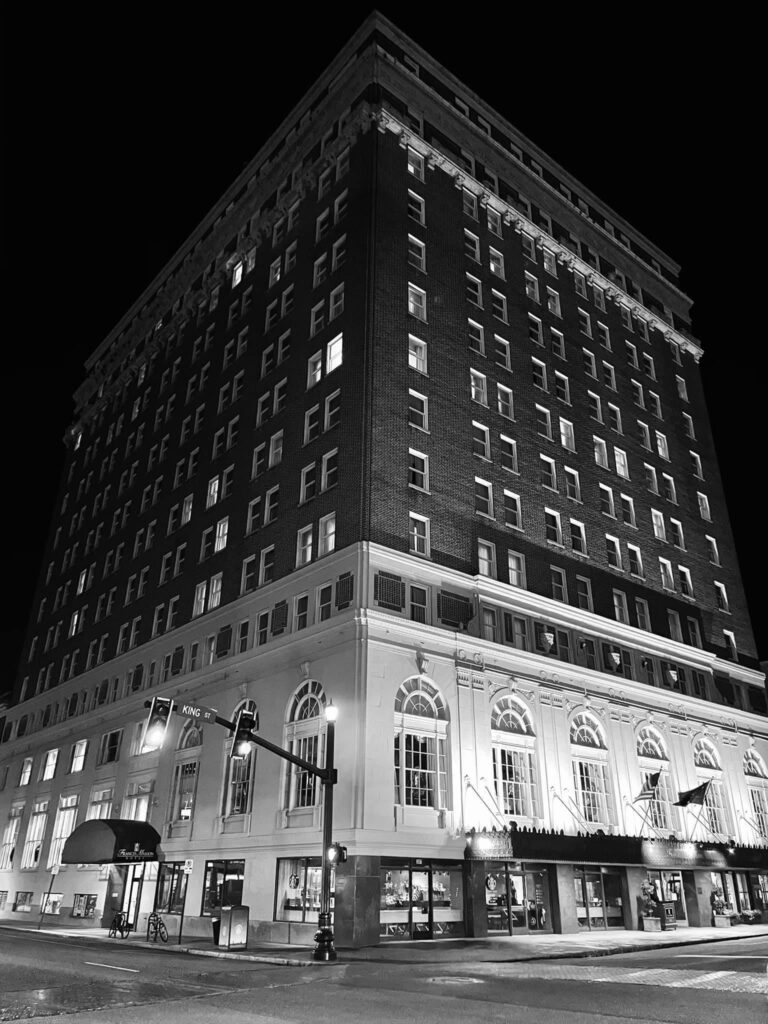
Shepard Fairey has several notable murals in Charleston, created during his 2014 exhibition “The Insistent Image” at the Halsey Institute of Contemporary Art. These include murals at the College Lodge on the College of Charleston campus, the Francis Marion Hotel, and Sottile Theatre, which is part of the Spoleto Festival USA. Additionally, there are murals on King Street and Calhoun Street, although some are at risk of being lost due to demolition.

The “Power and Glory” mural by Shepard Fairey is located on the Calhoun side of the College of Charleston dormitory, College Lodge (Note: This building is scheduled for potential demolition). It was created in 2014 as part of Fairey’s exhibition “The Insistent Image” at the Halsey Institute of Contemporary Art. The mural is one of the few remaining works from this project, as others have been lost or are at risk of demolition. Efforts are being made by local tech entrepreneurs to digitally preserve Fairey’s Charleston murals, including “Power and Glory,” to maintain their cultural significance.

Note: The artwork – Kamala Harris Forward is available for free download and is intended as a tool for grassroots activism, with Fairey not receiving any financial compensation for it.

Stay connected and subscribe to Charleston Daily.

Metavesco Executes Letter of Intent to Acquire Striped Pig Distillery and Local Choice Spirits of Charleston

Read More

CUMMING, Ga., Aug. 16, 2024 /PRNewswire/ — Metavesco, Inc. (OTC PINK:MVCO), a web3 enterprise and digital asset innovator, today announced the execution of a non-binding Letter of Intent (LOI) to acquire Striped Pig Distillery and Local Choice Spirits of Charleston. 

Founded as one of South Carolina’s oldest distilleries, Striped Pig Distillery has garnered multiple awards for its exceptional craft spirits. Local Choice Spirits has established a reputation for innovation and quality, solidifying its place in the market. 

The two companies are led by visionary entrepreneur “Pixie” Paula Dezzutti. Pixie is recognized as a top influencer in SC in 2024, listed by Forbes as “Top 50 Over 50” in 2023, and recipient of the International Woman of the Year Award by the Atlanta Chamber of Commerce in 2022. She has been a prominent figure in the industry, not only for her business acumen but also for her contributions to the broader business community. Listed by INC 5000 as one of the fastest growing companies of the Southeast, and SC Top 50 Fastest Growing Businesses, Local Choice and Striped Pig have plans to unveil an event center for its patrons. Upon closing this transaction, Ms. Dezzutti will be appointed as Chief Executive Officer of Metavesco, Inc.

Post acquisition, the businesses will operate as wholly owned subsidiaries of Metavesco, Inc. Highlights of the combined businesses include:

  • Approximately 1000 barrels of aged bourbon, valued at over $18,000,000 retail
  • 16 active product skus including vodkas, rums, gins, whiskeys, and tequila
  • Product distribution in 20 states and ecommerce availability in most
  • Distillery capable of producing 300 high quality bourbon barrels annually
  • World class management team with over 100 years combined industry experience

At closing, Metavesco will issue a combination of 2-year restricted common stock, preferred stock, and a 2-year convertible note in the amount of $2 million. Additionally, the Company will assume approximately $1.2 million in debt owed collectively by the acquired businesses. 

Metavesco, Inc. CEO Ryan Schadel stated, “I’d like to say this was a tough decision since it means I’ll be stepping down as CEO, but it wasn’t a tough decision at all! Ms. Dezzutti’s appointment as CEO will be a huge win for shareholders and she is poised to usher in a new era of innovation and growth. With a distinguished career that spans entrepreneurial success, industry recognition, and thought leadership, Pixie has consistently demonstrated an extraordinary ability to drive transformation and excellence. Her accolades, including her role as a featured panelist at the Atlanta Chamber of Commerce’s seminar on NFTs, cryptocurrencies, and Blockchain 3.0, along with her Amazon best-selling book, Alphabet Soup, outlining her pioneering NFT Bourbon release, underscore her forward-thinking approach and deep industry insight. She’s a force to be reckoned with and I believe Metavesco shareholders will be in good hands with her at the helm.”

Ms. Dezzutti stated, “Our team at Striped Pig Distillery and Local Choice Spirits has dedicated years to perfecting our craft, building a strong, regional brand of which we’re incredibly proud. This acquisition is the perfect opportunity to expand our reach and bring award-winning spirits to a national audience. The multi trillion-dollar beverage business needs pioneers to lead the charge in a quickly paced changing landscape. I am excited to lead Metavesco into this new era of growth and innovation and am confident that together we will achieve extraordinary success.”

While there is no guarantee that a deal will be finalized, all parties are working aggressively to prepare and execute a definitive purchase agreement with a 30-day closing deadline.

About Metavesco

Metavesco is a web3 enterprise and digital asset innovator. The Company has bitcoin mining operations at hosted facilities in KY and IA. Through its wholly owned subsidiary, the Company operates Boring Brew, a specialty coffee company utilizing owned and licensed NFT IP as unique packaging.

Safe Harbor Statement

This press release contains statements that constitute forward-looking statements. These statements appear in a number of places in this press release and include all statements that are not statements of historical fact regarding the intent, belief or current expectations of the Company, its directors or its officers with respect to, among other things: (i) financing plans; (ii) trends affecting its financial condition or results of operations; and (iii) growth strategy and operating strategy. The words “may”, “would”, “will”, “expect”, “estimate”, “can”, “believe”, “potential”, and similar expressions and variations thereof are intended to identify forward-looking statements. Investors are cautioned that any such forward-looking statements are not guarantees of future performance and involve risks and uncertainties, many of which are beyond the Company’s ability to control, and that actual results may differ materially from those projected in the forward-looking statements as a result of various factors. More information about the potential factors that could affect the business and financial results is included in the Company’s filings on otcmarkets.com.

SOURCE Metavesco, Inc.

Memories of Growing Up East of the Cooper – Stories about Life in Mount Pleasant, South Carolina 1930’s – 1970’s

Read More

Stories compiled by Tonya McGue

Mount Pleasant has changed a lot in the past 80 years, from a population of 1,700 in 1940 to over 86,000 now. The memories of those who grew up here years ago are treasures to keep and share. The following memoir stories reveal a time when the Old Village was the “downtown,” there was no dentist nor a bank in town, vegetables were stored under the porch, everyone had four-digit phone numbers, Wando High School’s first boys’ tennis team got beat by Ashley Hall and the fire department had to open one lane of the Grace Memorial Bridge during a snowstorm so a baby could be born in Charleston, since there was no hospital East of the Cooper.

Life in Mount Pleasant Before There Was a Dentist or a Bank in Town
– By William L. (Roy) Hills

My father bought our house — 121 Live Oak Drive — in 1930 for about $4,200. We heated the main part with a pot-bellied wood stove. In 1940, the town population was about 1,700. I was born in 1943.

The Mount Pleasant Boat Building Company on Shem Creek was big business, hauling and repairing boats of all types. My cousin Bob Magwood’s dock was stacked with boats including the “Geneva Moore,” “Ruth” and “The Boxcar.” My cousin Willie Magwood had a one-cylinder, Lathrop-powered shrimp boat, “The Skipper.” When they came in from a day of shrimping, a dozen women headed the baskets of shrimp with lively conversation, humming and singing.

What is now “the Old Village” was “uptown” or “downtown.” I loved to walk through Coleman’s Hardware store (now The Old Village Post House). Mr. Mashe was the postmaster, and most received their mail at the post office. I was too short to reach our combination box, so I just asked for our mail.

The first haircut I remember was in Mr. Crosby’s chair. They called him “Bing.” The Zeiglers ran The Pitt Street Pharmacy. We went to Dr. Freeman before a new doctor, Otis Pickett, set up his office. There was no dentist in town, so my mother took us to Charleston. I remember running away from the barber and the dentist. There was no bank in town, so we traveled across the Grace Memorial Bridge to the South Carolina National Bank.

I went to elementary school in the “new” two-story Mount Pleasant Academy, circa 1938, on the grounds of the now Moultrie Middle School. Harry Douty’s gas station and garage was located at the foot of the Shem Creek Bridge. After school, I stopped at Cope’s, bought a Popsicle and played the pinball machine if I had a nickel or two. When we swam off the Royall’s dock in Shem Creek, we floated up the creek to Buffy Green’s farm (now Cooper Estates) and stole a watermelon or two.

Mathis Ferry Road Porches, Vegetable Banks and Country Living
– By Barbara Fordham Collier

Vegetables were stored under the porch when I was a child. It was called “banking the vegetables,” and the spots were perfect for hide-and-seek. If the seekers took too long, a hearty snack and a little nap might be the outcome. “If you eat those raw vegetables, you’ll get ‘pain of stomach’ like you’ve never had!” the grown-ups would say. “Yeah right!” we thought. The frequent soirees we held in vegetable banks under a whole lot of porches assured us that these threats were idle. When our parents yelled, “Go get 10 sweet potatoes for dinner,” we prayed that there would be enough left.

In Scanlonville, nearly every house had a porch, and every porch was used for more than decoration. Important, private, meaningful, long-lasting conversations were held on those porches. If someone was interested in building a future with you, a “little talk” on the front porch with the parents was vital. In addition, porches were havens for storytellers who were well fortified in food and drink. We listened while sipping sweet iced tea and enjoying the “cooling Cooper River breeze.”

Gnats and mosquitoes reminded us that we were indeed “in the country.” Priming the hand-operated water pumps; going with cousins to move Jimmy, the cow, closer to or farther away from the house; and waiting for those seasons when the migrant workers exited buses and filed down Mathis Ferry Road headed to the fields all confirmed the truth of a different life in the country than that on the “other side” of the bridge.

We sat on our old porches and relished a loving community complete with one huge live oak. We appreciated our ancestors, anticipated bright futures, praised our children’s efforts, ate enthusiastically, laughed unashamedly, bore one another’s burdens and enjoyed that feeling of safety that is often elusive to us.

Life in Mayberry with a Pecan-Stealing, Fence-Jumping, Hitch-Hiking Childhood Partner in Crime
– By Billy Hennessy

Growing up in Mount Pleasant was like growing up in Mayberry. In 1955, when I was 5 years old, my family moved from Charleston to Mount Pleasant into a one-story brick house on a dirt road at 7 Dawson Terrace, now 1351 Erckmann Drive.

Kenny Kirchner was my childhood partner in crime, and I had a fun walk down memory lane thinking about our adventures below:

  • Fishing, crabbing, shrimping and occasionally falling off the Old Bridge. They call it the Pitt Street Bridge now.
  • Sitting on a stool at the Pitt Street Pharmacy fountain drinking a Cherry Coke.
  • Dancing at “Daniel’s Den” at Alhambra Hall on Friday night.
  • Exploring the haunted house next to Alhambra Hall.
  • Having the only policeman in Mount Pleasant, Skeeter Benton, confiscate my BB gun for shooting birds. He later delivered the gun to my house on a promise not to do it again.
  • Riding bikes into a cloud of DDT from the mosquito truck.
  • Cutting school and hitchhiking to the beach, sometimes with a surf board hanging out a window.
  • Having rotten tomato and cucumber fights at the packing sheds.
  • Jumping the fence at the Moultrie football games so we did not have to pay a quarter.
  • Having “Old Man” Royall catch us in his pecan trees stealing his pecans. Now Moultrie Shopping Center stands in the former grove.
  • Getting paid a nickel from Mr. Willard for picking up cigarette butts outside his hardware store.
  • Having Mr. Spoonheimer run us out of his air-conditioned drug store for reading comic books. The penguin on the door said, “Kool Inside.”
  • Hanging out at Choppy’s Gulf Station.
  • Buying candy and Cokes at Art Ruth’s 7 Day Store. Coke, including the bottle, was 10 cents.
  • … And, of course, climbing the water tower.

Washing Sheets in an Old Ringer Washer and Dialing Four-Digit Phone Numbers
– By Sally Burn Sweatt

At 12 years old, the product of a broken home, I told my part-time, weekend father that I wanted my own bed and to attend one school. Prior to that, I had gone to 11 schools. He was a traveling salesman with a little girl in tow, and he gravitated to the most beautiful, charming part of Charleston — East Cooper.

He found us a little cement block house on Cameron Boulevard on Isle of Palms. I thought I had died and gone to heaven. I had my own bed and fried my first buttermilk-battered chicken on a three-burner stove and a cast-iron skillet. Living on the island was like something out of a novel. Back then, it was quiet, and the houses were small, except for a few big ones scattered along the dunes. I washed our sheets in an old ringer washer under the palmetto tree while horn toads sunned on the patches of sandy grass. My dad and I crabbed at Breach Inlet, and I learned how to make deviled crab. We played bingo at Front Beach and fished off the old bridge on Sullivan’s Island. Everyone had four-digit phone numbers and a black clunky landline telephone. That same year the postal service implemented the Zoning Improvement Plan, or ZIP code.

In 1965, my father and I moved to Simmons Street in Mount Pleasant so that I could walk to General William Moultrie High School. I cannot think of anything more idyllic than growing up on the coast of South Carolina. It was pure enchantment, splendor in the sun, beach music, friendly safe neighborhoods with unlocked doors — and all this while the Vietnam War raged on the other side of the world and on our TV screens.

Wando’s First Tennis Team Loses to Ashley Hall
– By Russell Bridgham

Wando High School opened in the fall of 1973, and I played on the school’s first tennis team in the spring of 1974. We only had one player with tennis experience, Jon Nason, who played No. 1 for us. We were so bad that Coach Ward, our physics teacher, initially ranked us based on how much we changed our service motion to get the second serve in.

The highlight of the season was our match with Ashley Hall, a private school for girls. I played Mary Koester at No. 2 singles and was beaten badly in straight sets. In fact, I believe we lost all our matches to the girls, a 9 to 0 drubbing!

Our rematch with Ashley Hall the next year went a little differently. Our Warrior team had improved. I was fortunate to play at the No. 1 position and luckily beat Margaret Bradham in straight sets. Our team won 7 to 2!

Redemption! We finished the season with a 16-2 record and the knowledge that we could beat a very good girls’ high school tennis team.

A Child’s First Snowman and a Baby Born Across the ‘Grace’
– By Laura McGregor

On a mid-February weekend in 1973, when I was 7 years old, Mount Pleasant had a record-breaking snowfall. I had never even seen a snowflake before, and I still recall my overwhelming excitement and sense of joy. After watching “Frosty the Snowman” on television each December, I finally had the chance to build my own snowman in my front yard. My dad loaned us an old broom from the garage. My mom donated a long-neglected hat. We gathered sticks and pine cones, rolled out three large snowballs and stacked them on top of each other.

While my brother, David, and I built our first snowman, the Governor of South Carolina activated the National Guard. They patrolled the highways and rescued motorists, saved people trapped in their homes and airlifted food to those who were unprepared for the weather. Thousands of residents lost electricity. Property damages reached into the millions. It was a disaster for many people.
I have no idea if my family lost power at our home in The Groves. I don’t remember being cold, although I am sure I spent endless hours outside. My memory is of the crystal-clear, bright whiteness of my small world and of the joy of my first snow.

I also recall that our neighbor’s daughter-in-law went into labor at the height of the freeze, and there were no hospitals East of the Cooper. She needed to get downtown, but the only way over was on the rickety, rollercoaster of a bridge named “Grace,” which was closed for the duration of the winter “weather event.” Luckily, they opened one lane for this emergency, and a Mount Pleasant fire truck carried her into Charleston. Her baby was born during that magical weekend.

Source link: Charleston Retirement Lifestyle

South Carolina State University helps 400 women farmers with solar water system in The Gambia

Read More

By Sam Watson, Director of University Relations

The agricultural extension project is intended to mitigate food insecurity in the developing West African nation.

Note: This is the first in a series of articles regarding South Carolina State University’s academic exchange and agricultural extension partnership in the developing West African nation of The Gambia.

ILLIASSA, North Bank Region, Gambia – For over two decades, Saffiatou Jammeh has worked the soil in a community garden near her village to grow onions and other vegetables to feed and earn money for her family.

“I have been working here 22 years. When we were coming here in those early days, we even had to cut the trees because it was bushy,” Jammeh said through an interpreter. “In the past, one of our challenges was fencing around this garden to keep animals out. We had to go into the thick bush and cut some wood to make a fence.”

As the years went on, yields from the garden diminished because of insufficient water. Wells dried up, and the equipment used to draw water was worn out. Approximately 400 women who tended plots in the garden saw their livelihoods jeopardized by the conditions.

“In the past, my gardening was very bad,” Jammeh said. “My husband asked me to stop because the production was limited because of the scarcity of water. My husband asked me to stop working because the benefit wasn’t coming.”

Now, thanks to a project led by South Carolina State University’s Public Service and Agriculture division (SC State PSA), the community garden has an abundant supply of water.

Funded through the U.S. Department of Agriculture via the 1890 Universities Foundation Center of Excellence for Global Food Security and Defense (GFSD) at the University of Maryland Eastern Shore, the new solar-powered well and pump system delivers water to 49 new and renovated concrete reservoirs throughout the fields. The system’s tanks have a 30,000-liter capacity. SC State also provided buckets and watering cans for water distribution.

“When we had limited water, I used to have about six bags of onions from my garden, but now with this water supply system here, I can have double or even more because of the availability of water anytime we need it,” Jammeh said. “So, I will have more and more yield with more onions to sell.

“These days, I come twice a day,” she said. “I can come in the morning because there is abundant water, and I even come back in the evening and then I can go back and sleep. It has been transformative and has eased my life and constraints these days.”

The water system resulted from the GFSD’s 2021 needs assessment of agriculture sector and food supply chain systems in several African countries.

With SC State PSA’s Dr. Lamin Drammeh, the grant’s principal investigator, coordinating the efforts, the university entered a partnership with Gambia’s National Agricultural Research Institute (NARI) and the Ministry of Agriculture. Dr. Joshua Idassi, SC State PSA’s state program leader for sustainable agriculture and natural resources,  worked alongside Drammeh, Gambian officials and the farmers to design and implement the project.

Fast facts about the project:

  • Title: Cultivating Productivity and Resilience to Mitigate Food Insecurity in the Gambia.
  • Beneficiary: Illiassa Women Garden Kafo, Gambia
  • 10 new concrete reservoirs.
  • 39 renovated reservoirs.
  • 30,000-liter water tank system.
  • 12 units of solar power system (385W/32V) per unit.
  • Water network to the reservoirs.
  • Water meter system.
     

Global impact and benefits for SC State researchers and students

The garden project represents the first of a series of ongoing initiatives between SC State and the West African nation, which also include an academic and research exchange with the University of the Gambia. SC State President Alexander Conyers described the international relationship as fulfilling the university’s global outreach objectives and its educational commitment to SC State students.

“When we help others, we help ourselves,” Conyers said. “When we teach others, we teach ourselves. These relationships and experiences are key for our students as they compete on a global scale. It’s essential for SC State to be involved globally.”

Dr. Louis Whitesides, SC State’s vice president for PSA and research, described how the impact of the university applying its knowledge around the world. He noted that SC State’s next Gambian venture will be the introduction of a new goat species in hopes of mitigating nutritional deficiencies causing stunting in children.

“As a global citizen, SC State University has a responsibility to invest in communities around the world who would benefit from our expertise, particularly in agriculture education, research and outreach,” he said. “SC State Public Service and Agriculture leads this work on behalf of the university by leveraging its resources, technical expertise and research-based knowledge to transform communities, not just in South Carolina but globally.

“For Gambia, much like the U.S., agriculture is the leading economic industry,” Whitesides said. “The work we are doing in the country will advance agriculture innovation and practices that will produce far-reaching outcomes that will impact Gambians for countless generations.”

A jubilant celebration

On Aug. 6, Conyers, Whitesides and Drammeh joined Gambian officials and SC State PSA scientists in handing over the water system to the garden’s farmers. The event was a joyous occasion filled with song, dance and a traditional Gambian feast.

“Ladies, South Carolina State University heard your request, and this is for you,” Conyers said as he addressed the farmers with an interpreter. “You deserve this and more.”

The SC State president drew parallels between the agricultural economies of South Carolina and the West African nation, including the production of sweet potatoes and peanuts.

“What we are doing for you today is what we do for the citizens of South Carolina, and that is to innovate, educate and elevate,” he said. “When we empower women in the Gambia, we empower the entire Gambia, just like when we empower women in the United States, we empower the entire country. When we empower women, women help us empower children, and those children help us empower the entire community.

“We continue to pray for your blessings, and I ask that you pray for South Carolina State University so that we can continue to do this type of work throughout the world,” Conyers said. “Many blessings to you, your family and this great country.”

A thankful nation

Conyers was joined on the program by Gambian and village dignitaries, including North Bank Region Gov. Ebrima KS Dampha and Minister of Agriculture Demba Sabally, who both expressed gratitude for SC State’s intervention at the garden and their hopes for the relationship’s sustainability.

We are very grateful for this. Your works here will transform lives,” Sabally said, “It will transform livelihoods and make these women increase their income, increase their access to health and increase their access to education.

“NARI being under the Ministry of Agriculture will continue to work with these women to move this garden to a better height,” he said.

Dr. Demba B. Jallow, NARI’s director general, described the water project’s domino effect for the people of Illiassa.

“Horticultural needs a lot of work, but if they do not have access to water, the garden is there, but nothing will grow in it,” Jallow said “About 400 women are working this garden, so this will help them a lot. They grow all kinds of vegetables, but the major ones are tomatoes, onions, okra and garden eggs (a small type of eggplant).

“For this community, it will create a source of income for them, especially for young people,” he said. “Young people have some beds here where they can produce and sell for themselves. This area is known for having some migrating youths, especially to Europe and the U.S. If they have something like this, it will keep them home with their families.”

In that same vein, Jallow lauded Drammeh, a native of Gambia, for his leadership in connecting his native country to his adopted home in the U.S.

“This is what is expected of every Gambian,” Jallow said. “If you go abroad, you bring back something that will uplift the living conditions of your people. This is really commendable on his side. Dr. Drammeh can stay in America and have everything, but he came back home and contributed to the development of his country.”

Further needs and next steps

While access to water was the farmers’ most pressing necessity, Jallow said they still have unmet needs to tend to their fields and protect their crops. He said NARI’s top priority is a storage facility to prevent crops from wilting before the farmers can get them to market.

“Most of the vegetables are highly perishable – tomatoes for example. They need a place they can store the vegetable and get what they can to market,” he said. “If they do not have a place to store these things, it means their hard work can be in vain.”

Next on the list would be machines to help them plow rather than relying on “muscle power.”

“They use donkeys and horses and their own muscles, which is not very efficient,” Jallow said. “What they need is small power tillers to help them till the soil and prepare their beds.”

Jallow expressed his gratitude for SC State’s transformational partnership with NARI and the promise of the ongoing relationship.

“To the people of South Carolina, the government of the U.S. and South Carolina State University, I want to say thank you very much,” he said. “This is a rare thing for us to have something of this magnitude.”

Source Link: SC State University

Charleston Business Spotlight:  Bright Light Bakery:  The Little Bakery Around the Corner

Read More

By Mark A. Leon

It is often said, great things come in small packages.  In the case of Bright Light Bakery, founded by College of Charleston Alum Nour Bizri, that small package is the savory and sweet delight of made from scratch breads, biscuits, scones and croissants.

To truly understand the passion behind Bright Light Bakery, you need to hear Nour’s story:

About Bright Light Bakery and Founder Nour Bizri

Nour Bizri is a Licensed Professional Counseling Associate and the owner of Bright Light Bakery. 

Bright Light Bakery is a cottage home-based bakery that specializes in artisan sourdough bread and treats.

Originally introduced to sourdough by her sister, Nour began selling sourdough bread and treats in Killeen, Texas while her husband, graduate of The Citadel, was serving in the U.S. Army. Most weekends, they went to the Farmers Markets and it became a routine to sell the bread and treats that she made. 

After her husband’s retirement, they decided to move back to Charleston, where they had originally met during their college years. Nour graduated from the College of Charleston with a BA in Psychology, and her husband graduated from The Citadel in 2021.

In 2018, Nour was involved in a freak accident and sustained a traumatic brain injury, which led to a diagnosis of Functional Neurological Disorder. This neurological processing disorder affects a person’s mental, emotional, and physical processing. To put it simply: instead of being able to fight, avoid, or flee from a stressful situation, her body physically manifests her anxiety through seizures. Finding the process of making sourdough bread provided Nour with a way to slow down, process, and understand her thoughts and feelings in real time, which helped decrease my seizures. 

“The purpose of Bright Light Bakery is not only to bring simple and clean bread the Charleston community but also to raise awareness about normalizing conversations about mental health in our everyday lives.” – Nour Bizri, Founder

How do I order?

Bright Light Bakery is a home-based bakery in West Ashley (Charleston, SC) with pick up offers every Friday.

To order for Porch Pick up on Friday’s, go to Bright Light Bakery’s online storefront at www.hotplate.com/brightlightbakery or send them a message on Facebook or Instagram! To follow them for market days, pop-ups, and to know what is too come follow them on their social media pages as well!