On the 8th of November, 1718, twenty-nine pirates from the crew of the Revenge, members of pirate Captain Stede Bonnet’s crew, were executed in Charles Town, South Carolina.
The men had been brought as captives back from the Cape Fear River by Colonel William Rhett, along with Captain Bonnet, and since the beginning of the month, the pirates had undergone eleven trials. Found guilty, on November the 8th (a Saturday) the men were hanged until dead “at the White Point near Charles-Town” according to published transcripts from 1719 regarding the event.
”The White Point” at that time referred to a publicly owned site of oyster shoals exposed at low-tide, a landmark visible to all in the harbor; a prime location to ensure the select dangling corpses on display would be seen as a warning to those contemplating a life of piracy. Later in the month, 19 more pirates from the crew of Captain Richard Worley would be hanged here as well, and four and a half weeks later, Captain Stede Bonnet would be hanged at the same location.
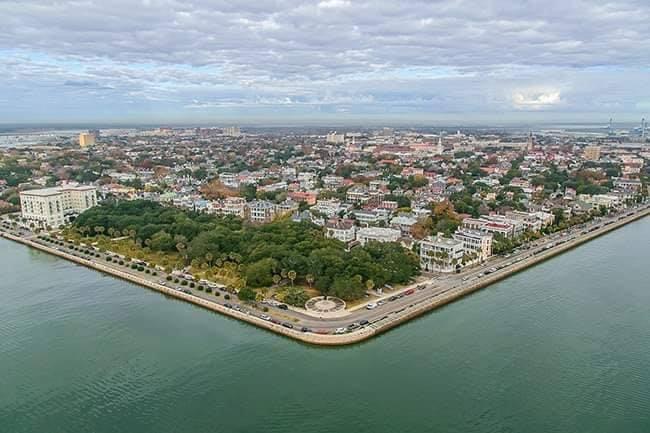
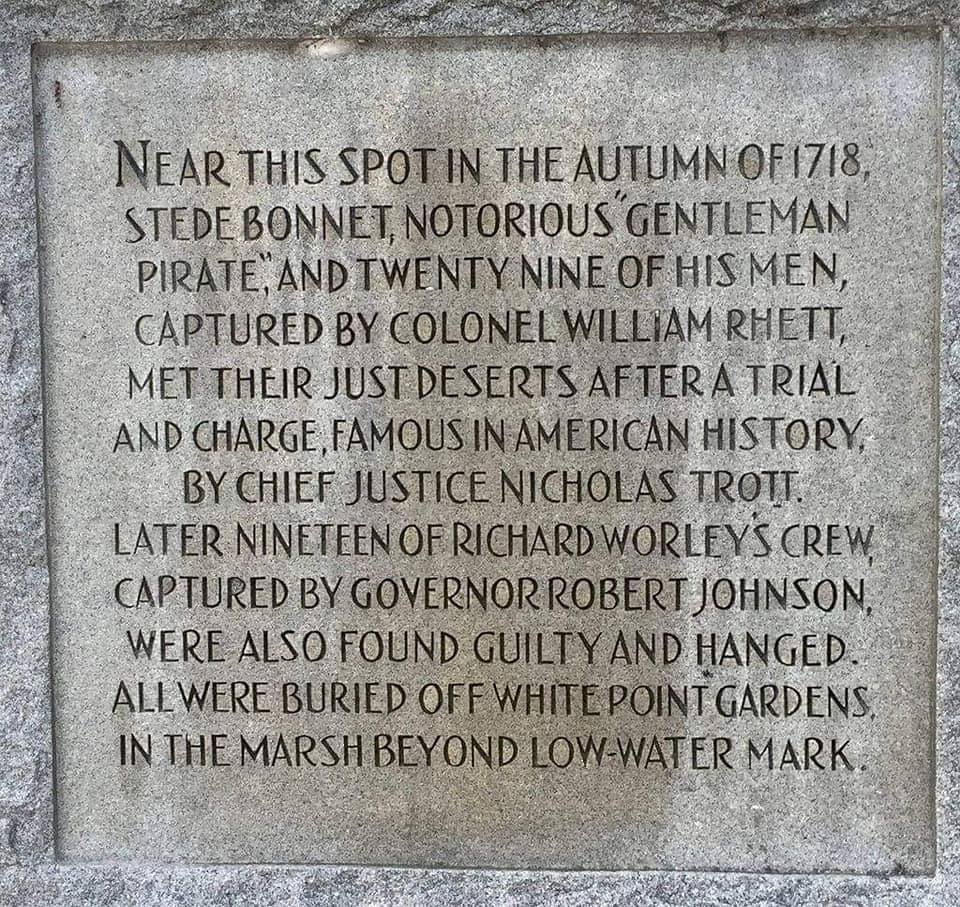
(Pictured is a period map displaying the White Point transposed over-top current Google Satellite [with White Point Gardens being the green square nearest to the corner], an aerial photo from above Charleston’s harbor showing where White Point once was, and the memorial stone in the park)
Today, White Point Garden sits atop the Battery, which overlooks where “the White Point” once was, and in this location is a memorial marker to those executed nearby.
South Carolina emerged as the nation’s top magnet for Gen Z talent in 2023, attracting a net gain of over 24,100 young adults—outpacing all other states in the competition for tomorrow’s workforce, according to StorageCafe’s latest migration study based on the Census data.
Key findings include:
South Carolina gained over 72,400 more residents than it lost in 2023, fueling a net inflow of over 500K since 2014, and was the fourth most popular destination after Texas and Florida.
Nearly 1 in 2 movers (46%) achieve homeownership within just a year of relocating.
Additionally, The Palmetto State is drawing in a well-educated demographic. A full 29% of its new residents have earned at least a bachelor’s degree. Also, an appreciable 20% of those moving in are working from home.
Neighboring North Carolina and Georgia sent the most new residents, and when transplants from these states can potentially save between 12% and 16% on home purchasing costs, it’s easy to see the appeal.
I’ve asked Emilia Man, the lead analyst behind the story, to share her insights on the recent migration trends:
‘Interstate and regional migration patterns are shifting, and South Carolina is at the center of the movement. The state’s affordability, lower housing costs, and strong development activity are drawing new residents in search of better living conditions. With active construction meeting demand, South Carolina offers diverse housing options for both buyers and renters.
Within its booming metro areas, a notable trend is emerging—more residents are moving from core cities to fast-growing outer suburbs. These areas provide more space, attainable pricing, and thriving communities while keeping people connected to major economic hubs. These shifts are reshaping South Carolina’s housing market, fueling both urban and suburban growth.’
For a comprehensive analysis, you can access the full report here:
ATLANTA, March 18, 2025 /PRNewswire/ — Governor Brian P. Kemp today announced that TriNet is planning to create 750 new jobs at a new corporate center in Dunwoody, Georgia, over the next five years, representing an estimated $15.4 million in investment in DeKalb County.
“As the No. 1 state for business, one of the key drivers of our success is our metro Atlanta area that continues to attract a strong ecosystem of job creators like TriNet,” said Governor Brian Kemp. “TriNet’s services for small businesses will further that network while creating meaningful jobs and investment for the Dunwoody and Dekalb County community.”
TriNet provides comprehensive HR solutions, technology, expertise, and access to world-class benefits that enable small and medium-sized businesses (SMBs) to attract and develop top-tier talent.
“We look forward to opening a new TriNet office in metro Atlanta and becoming a part of this vibrant and growing business community,” saidMike Simonds, TriNet President and CEO. “We are excited to partner with Atlanta’s strong universities and thriving small business ecosystem as we expand our local team and establish a hub where TriNet colleagues from across the country can come together for training, development, and collaboration to better serve our customers.”
“At TriNet, our people are the heart of everything we do, and we are thrilled to expand our team here in metro Atlanta,” said Catherine Wragg, TriNet Chief People Officer. “This new office will help us attract top talent, foster our strong culture of collaboration and making an impact, and further invest in the professional growth of our colleagues. We are committed to creating a workplace where our colleagues can thrive and look forward to making a positive impact in this community.”
TriNet’s new approximately 150,000-square-foot space will be located in Dunwoody. The company will immediately begin hiring for technology, HR consulting, client management, and sales roles, with plans to leverage its increased presence to grow its regional Atlanta and Southeast customer base. To learn more about TriNet, including where interested individuals can apply for jobs, visit www.trinet.com/about-us/careers.
“Dunwoody provides the ideal setting for TriNet, offering unparalleled access to the region’s talented workforce and a vibrant, mixed-use environment surrounded by top-tier restaurants, shops, and entertainment,” said Dunwoody Mayor Lynn Deutsch. “We are thrilled to welcome TriNet, whose investment will bring hundreds of new jobs to our community. This is another example of a growing company choosing Dunwoody.”
“TriNet’s investment in DeKalb County is a testament to the strength of our workforce, our infrastructure, and our commitment to fostering a thriving business environment,” said DeKalb County CEO Lorraine Cochran-Johnson. “The creation of 750 new jobs will bring invaluable opportunities to our residents while reinforcing DeKalb as a premier destination for corporate growth and innovation. We proudly welcome TriNet to our community and look forward to the positive impact this expansion will have on our local economy and workforce.”
“TriNet’s investment in DeKalb County will create jobs, drive innovation, and strengthen our economy,” said Katie Kirkpatrick, President and CEO of the Metro Atlanta Chamber. “With direct access to a pipeline of emerging talent from metro Atlanta’s renowned universities, TriNet is uniquely positioned to connect businesses with the next generation of HR and business professionals.”
Assistant Director of Statewide Projects John Soper represented the Georgia Department of Economic Development’s (GDEcD) Global Commerce team on this project in partnership with the City of Dunwoody, Decide DeKalb, Metro Atlanta Chamber, University System of Georgia, and Georgia Power.
“TriNet’s decision to locate in Georgia reflects the confidence companies have in the state as a hub for innovation, talent, and long-term success,” said GDEcD Commissioner Pat Wilson. “Strong partnerships between industry, communities, and higher education drive economic growth. We’re excited about the opportunities this investment will bring and congratulate Dunwoody and DeKalb County on this milestone. Welcome to Georgia, TriNet!”
About TriNet
TriNet (TNET) provides small and medium-sized businesses (SMBs) with HR solutions and offers access to human capital expertise, benefits, risk mitigation, compliance, and payroll services, all enabled by industry-leading technology. TriNet’s suite of products also includes services and software-based solutions to help streamline workflows by connecting HR, benefits, employee engagement, payroll, and time and attendance. Rooted in more than 30 years of supporting entrepreneurs and adapting to the ever-changing modern workplace, TriNet empowers SMBs to focus on what matters most – growing their business and enabling their people. For more information, visitTriNet.com.
Charleston, known for its vibrant culinary scene, offers a variety of restaurants serving delicious mussels. Here are some great places to indulge in this seafood delight:
Located at 64 Spring Street, Bistronomy by Nico is a French-inspired bistro that offers a modern take on classic dishes. Their mussels are a standout, often served with French fries and a flavorful sauce. The cozy atmosphere and extensive wine selection make it an ideal spot for a sophisticated dining experience.
This casual, yet upscale seafood hall located in the heart of Market and East Bay offers a variety of seafood dishes aside from the mussels as well as great vibes and people watching. There is no mistaken the positive energy from wall to wall. After dinner make sure you stop at Carmella’s across the street for a Tiramisu or espresso martini.
This waterfront restaurant serves fresh local seafood and offers a vibrant raw bar experience, though mussels might not be a regular feature, it’s worth checking their seasonal offerings.
For a truly memorable mussel experience, Bistronomy by Nico, Amen Street and Fleet Landing are must-visits, offering a unique blend of fine seafood and Charleston charm.
Robert Jordan, born James Oliver Rigney Jr. on October 17, 1948, in Charleston, South Carolina, left an indelible mark on the world of fantasy literature with his monumental series The Wheel of Time. His journey from a curious child to a celebrated author is one of resilience, creativity, and dedication.
Early Life and Education
James Oliver Rigney Jr. displayed an extraordinary intellect from a young age. By the age of four, he had taught himself to read with the help of his older brother. By five, he was already immersed in the works of Mark Twain and Jules Verne, sparking his lifelong love for storytelling.
Rigney attended The Citadel, the Military College of South Carolina, where he earned a degree in physics. His time at The Citadel instilled discipline and a sense of duty that would shape his career and writing.
Military Service
Rigney served two tours in Vietnam as a helicopter gunner in the U.S. Army. His bravery earned him numerous honors, including the Distinguished Flying Cross, the Bronze Star with “V,” and two Vietnamese Gallantry Crosses. This period of his life profoundly influenced his worldview and writing. Themes of honor, sacrifice, and camaraderie—central to The Wheel of Time—reflect his military experiences.
Service in Vietnam
Transition to Writing
After returning from Vietnam, Rigney embarked on a career as a nuclear engineer for the U.S. Navy. However, his passion for storytelling remained undiminished. In 1977, inspired by his love for literature and encouraged by friends, he began writing professionally. Initially publishing historical fiction under the pseudonym Reagan O’Neal and westerns as Jackson O’Reilly, Rigney honed his craft across genres before turning to fantasy.
The Wheel of Time
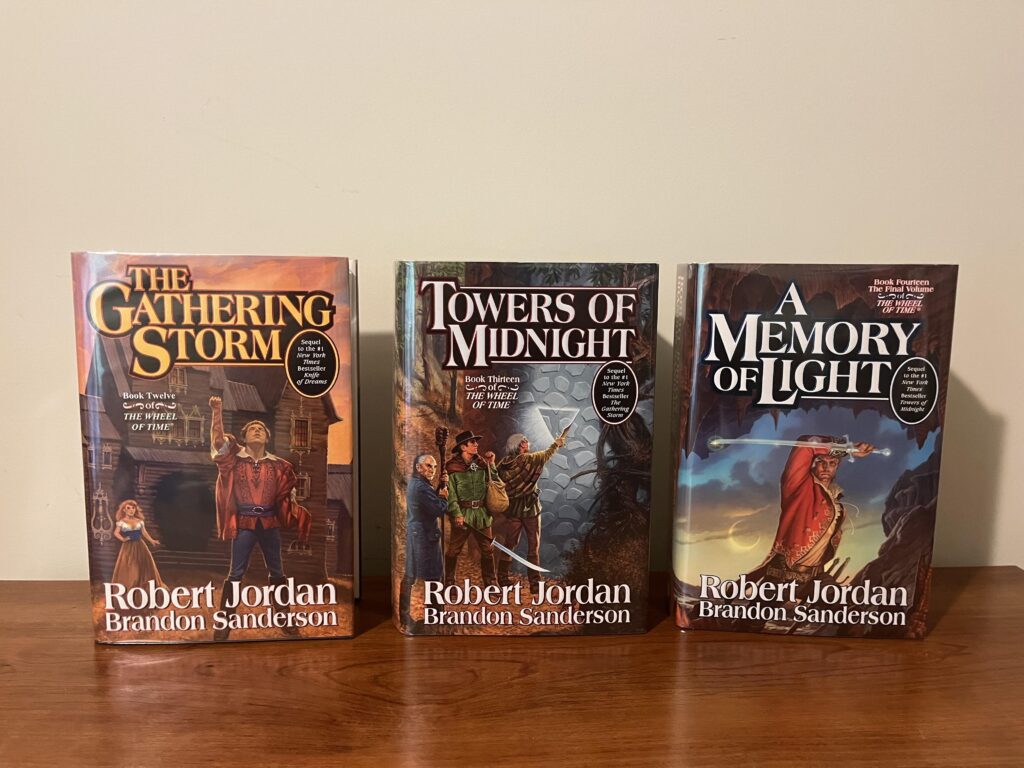
In 1990, Rigney—now writing under the pen name Robert Jordan—published The Eye of the World, the first book in The Wheel of Time series. Originally envisioned as a trilogy, the series expanded into 14 volumes plus a prequel novel. Drawing from European and Asian mythologies as well as philosophical concepts like balance and duality, Jordan created an intricate world filled with magic, prophecy, and richly developed characters.
Jordan’s writing process was unique; he avoided strict outlines and instead engaged in constant dialogue with his evolving story. This allowed characters to grow organically beyond their original models. The series became one of the most beloved in fantasy literature, selling over 90 million copies worldwide by 2021.
Personal Life
Jordan married Harriet McDougal in 1981. Harriet was not only his wife but also his editor and collaborator throughout his career. The couple lived in Charleston in a historic house built in 1797—a fitting home for someone deeply connected to history and storytelling. Beyond writing, Jordan enjoyed outdoor sports like hunting and fishing as well as indoor hobbies such as poker, chess, and pipe collecting.
Illness and Passing
In 2006, Jordan was diagnosed with amyloidosis, a rare blood disease that affects organ function. Despite undergoing treatment and maintaining hope for recovery, he passed away on September 16, 2007, at the age of 58 in Charleston. Before his death, Jordan prepared extensive notes to ensure that The Wheel of Time could be completed. Brandon Sanderson was chosen to finish the series based on these materials.
Legacy
Robert Jordan’s legacy endures through The Wheel of Time. The series has inspired adaptations across media, including comics, games, and a television show that premiered in 2021. His work continues to captivate readers with its depth and complexity.
Jordan’s life exemplifies perseverance—from overcoming challenges in war to crafting one of fantasy’s most ambitious sagas. His contributions to literature remain unparalleled, cementing him as one of Charleston’s most celebrated authors.
Clemson University is partnering with Hebrew University and Sapir College to help bring innovation and economic growth to Israel’s Western Negev region.
The partnership focuses on joint research initiatives addressing agricultural, nutritional, and environmental issues relevant to both Israel—particularly the Western Negev region—and South Carolina.
It involves helping establish a new agro-tech program in the Sapir College Department of Advanced Technology and Engineering. Leaders from the three institutions and governments met on March 11 to sign a Memorandum of Understanding (MOU) formalizing the collaboration.
Ambassador and 1994 Clemson graduate Nikki Haley says this partnership among agriculture experts will “…benefit all involved.”
“This partnership unites two countries, two cultures and three universities,” said Ambassador Nikki Haley, a 1994 Clemson graduate, Clemson Board of Trustees member and former South Carolina governor. “Today, we celebrate two agriculture giants, two leaders in innovative farming coming together. Through this partnership, we are sowing seeds that will sprout and bear fruit for generations to come.”
The collaboration follows a visit by Haley to Sderot in May 2024. There, she met Amit Kochavi, senior adviser to Sderot Mayor Alon Davidi. Kochavi had a bold idea to revitalize agricultural communities near Sderot and Sapir College after the Oct. 7, 2023, Hamas attack devastated the area.
His idea was to create a collaboration between Israel and the U.S. to help drive economic growth in the Western Negev region.
“At a time when hatred and violence seek to divide, we are building bridges of hope, prosperity, academic excellence and innovation,” Kochavi said. “This collaboration proves that the U.S. and Israel are not only strong allies but also partners in shaping a better future through education, technology and unwavering resilience.
“By working together, we can turn challenges into opportunities to help drive economic growth.”
Haley agreed.
“As a land-grant university, Clemson is built for this mission,” Haley said. “Israel has a productive agricultural system, and this collaboration will benefit all involved.”
Agro-tech involves using technology to optimize farming practices, including crop production, livestock management and post-harvest handling.
Boosting agricultural innovation
Jagger Harvey, global agriculture expert and director of the Clemson Global Research Initiative, is leading Clemson’s involvement.
Jagger Harvey
“Hebrew University scientists are world-class in agricultural research, and Sapir College supports agriculture in the Western Negev region,” Harvey said. “This partnership will further strengthen Clemson’s ability to address key agricultural and food insecurity challenges in South Carolina, Israel and globally.”
Despite its arid climate and limited resources, Israel has developed one of the world’s most productive and efficient agricultural systems. Clemson Provost Bob Jones said South Carolina could learn from Israel’s advancements in water conservation, sustainable farming and crop resilience.
Provost Bob Jones
“As a land-grant institution, Clemson University is uniquely positioned to support Sapir College’s expansion into agro-tech,” Jones said. “And, we have much to gain with our Israeli partners. Israel’s advancements in agriculture are nothing short of extraordinary.”
Clemson College of Agriculture, Forestry and Life Sciences DeanMatthew Holt said this collaboration is a testament to University founder Thomas Green Clemson’s will “…to establish the business of agriculture upon a prosperous basis…”
“This MOU is a message of hope and collaboration,” Holt said. “We must collaborate if we are going to feed everyone on our planet. I am confident we are laying the foundation to make a positive impact for future generations.”
Investing in the future of farming
Academics and research will play a significant role in Sapir College’s agro-tech program. Saul Burdman, dean of The Hebrew University Faculty of Agriculture, Food and Environment, said research, education, international collaboration and community engagement are the cornerstones of this partnership.
“This collaboration signifies a pivotal advancement in agricultural research and education,” Burdman said. “By combining Israeli expertise with Clemson University’s innovative approaches, we are poised to make significant strides in promoting global food security.”
Everything else can wait, but not agriculture.Jawaharlal Nehru, India’s first prime minister
Burdman noted that the Western Negev, particularly the Otef Aza region near Gaza, is critical for Israel’s food supply. The area produces 60% of the country’s potatoes, 50% of its tomatoes, 40% of its carrots, 30% of its wheat and 30% of its citrus.
He closed his remarks with a quote from Jawaharlal Nehru, India’s first prime minister: “Everything else can wait, but not agriculture.”
A united commitment
The event included representatives from Hebrew University, Sapir College and the city of Sderot. In addition to Burdman, other Hebrew University delegates included Yael Helman, vice dean for international affairs; Israel Rozenboim, vice dean for research and development; Sivan Yagel, faculty coordinator of funds and research affairs; and Yael Mishael, vice dean for academic affairs.
Sapir College was represented by Gail Gilboa-Freedman, dean of the faculty of technology, and Lily Mondaca, a leading agro-tech expert at their facility.
“Education is a basic human right,” Gail Bilboa-Freedman, Sapir College, Israel.
Though unable to attend in person, Sderot Mayor Davidi sent a recorded message thanking Clemson for its support.
“We are in a very difficult situation here,” Davidi said. “But with this collaboration, we can create a better future for everyone.”
The Hebrew word “Tikvah” was used several times during the meeting. For Jews, “Tikvah” means “Hope.” This word has many meanings associated with it. In the Hebrew context, hope is more than a dream; it is an expectation, a strong expression of faith.
According to the Fellowship of Israel Related Ministries, “Hope looks to the future, postured for something greater. It looks with expectation that something will happen.”
The motto for this collaboration is “Tikkun Olam – Nourishing the Future.”
Bennettsville Printing and SOPAKCO have both announced expansions of operations in Marlboro County South Carolina. Here are the details on both.
Bennettsville Printing expanding Marlboro County operations
COLUMBIA, S.C. – Bennettsville Printing, a fabric printer, today announced it is expanding its operations in Marlboro County. The company’s $8.4 million investment will create 24 new jobs.
A subsidiary of SNC Technical Services, Bennettsville Printing provides home, industrial, and military textile printing, dyeing and finishing services. The company has over 25 years of experience and specializes in printing camouflages for the U.S. armed forces.
Located at 410 Highway 385 in Bennettsville, Bennettsville Printing will expand its existing fabric printing manufacturing system, including updated production equipment and building improvements.
Operations are expected to begin by the end of 2025. Individuals interested in joining the Bennettsville Printing team should visit the company’s careers page.
QUOTES
“At Bennettsville Printing, we are proud to deepen our commitment to Marlboro County, the state of South Carolina and our local community with this $8.4 million investment. This expansion not only strengthens our operations but also creates 24 new jobs, reinforcing our dedication to economic growth and long-term partnerships in the region. We look forward to continuing our role as a key contributor to the local textile industry and the prosperity of the community we proudly call home.” -Bennettsville Printing General Manager Frank Goenz
“Bennettsville Printing’s expansion announcement reinforces South Carolina’s reputation as an exceptional place to do business. We are proud to celebrate Bennettsville Printing’s continued success in our state and the additional jobs it is creating in the Marlboro County community.” -Gov. Henry McMaster
“It is always exciting when a company expands operations in one of our rural communities, and today, we celebrate Bennettsville Printing’s decision to invest $8.4 million in its Marlboro County facility. We congratulate the company on this announcement and are grateful for the continued commitment to South Carolina.” -Secretary of Commerce Harry M. Lightsey III
“Teamwork makes the dream work. We understand here in Marlboro County that economic development is a team sport. Any successful coach will tell you that teamwork wins championships. We would like to thank Bennettsville Printing for choosing Marlboro County for their next expansion.” -Marlboro County Council Chairman Anthony Woods
FIVE FAST FACTS
Bennettsville Printing is expanding its operations in Marlboro County.
The company’s $8.4 million investment will create 24 new jobs.
Bennettsville Printing is a fabric printer.
The company is located at 410 Highway 385 in Bennettsville, S.C.
Individuals interested in joining the Bennettsville Printing team should visit the company’s careers page.
SOPAKCO expanding Marlboro County operation
SOPAKCO, a world leader in processed foods, today announced it is expanding its operations in Marlboro County. The company is investing $22.8 million to grow its Bennettsville manufacturing operation.
Founded in 1943 and headquartered in Mullins, SOPAKCO specializes in the design, processing and packaging of ready-to-eat meals and is a leading supplier of combat rations to the U.S. military. The company’s customers include federal, state and local agencies, as well as commercial retailers.
SOPAKCO’s investment will include the renovation of an existing facility and construction of an additional facility to expand the company’s food products manufacturing operation located at 320 Broad Street in Bennettsville.
Operations are expected to be online in October 2025.
QUOTES
“SOPAKCO has experienced great success in South Carolina. The value that Marlboro County brings through its business-friendly climate and quality workforce has allowed us to thrive here, and we look forward to continuing our partnership.” -SOPAKCO President Lonnie Thompson
“SOPAKCO’s $22.8 million investment in Marlboro County reinforces a strong commitment to South Carolina. We congratulate SOPAKCO on this expansion and look forward to supporting the company as they continue making a positive impact in our state.” -Gov. Henry McMaster
“SOPAKCO’s ongoing success in Marlboro County reinforces that South Carolina has the resources businesses need to continually grow and thrive. We applaud SOPAKCO’s latest investment in our state and celebrate the company’s decision to grow its footprint in one of our rural communities.” -Secretary of Commerce Harry M. Lightsey III
“There is a reason why we have two ears and one mouth. It’s because we’re supposed to listen twice as much as we talk. We are listening to our industries and getting results. We want to thank SOPAKCO for choosing Marlboro County for their next expansion.” -Marlboro County Council Chairman Anthony Woods
FIVE FAST FACTS
SOPAKCO is expanding its operation in Marlboro County.
The company is investing $22.8 million to grow its Bennettsville manufacturing operations.
SOPAKCO is a world leader in processed foods.
The company is located at 320 Broad Street in Bennettsville, S.C.
Operations are expected to be online in October 2025.
Saint Patrick, the patron saint of Ireland, is celebrated globally on March 17, but his life story is far more remarkable than the legends surrounding him. Born as Maewyn Succat around 385 AD in Roman Britain (modern-day Scotland or Wales),
Patrick’s journey from slavery to sainthood is one of faith, resilience, and dedication to spreading Christianity.
Early Life and Enslavement
Patrick was born into a Romanized Christian family; his father was a deacon, and his grandfather a priest. However, Patrick himself was not particularly religious during his early years.
At the age of 16, his life took a dramatic turn when Irish raiders captured him during a raid and sold him into slavery in Ireland. He spent six years in captivity, working as a shepherd under harsh conditions.
During this time, Patrick turned to prayer for solace and underwent a profound spiritual transformation. He later wrote in his autobiographical Confessio that his faith deepened as he prayed hundreds of times daily.
One night, he dreamed of escaping, hearing a voice telling him that a ship awaited him. Following this vision, Patrick fled over 200 miles to the Irish coast, where he found passage back to Britain.
Return to Ireland as a Missionary
After reuniting with his family in Britain, Patrick had another vision—this time calling him back to Ireland to spread Christianity. Determined to fulfill this mission, he studied for the priesthood in France under the guidance of Saint Germanus. By 432 AD, Patrick was ordained as a bishop and sent by Pope Celestine I to evangelize Ireland.
Patrick’s mission was not easy.
He faced resistance from local chieftains and Druids but gradually won over converts through his teachings and actions. He is credited with baptizing thousands, ordaining priests, and establishing churches across Ireland. Patrick also incorporated elements of Irish culture into Christian practices, such as using the three-leafed shamrock to explain the Holy Trinity.
Legacy and Death
Patrick’s work transformed Ireland from a predominantly pagan society into a Christian one. He served as the first bishop of Armagh and Primate of Ireland, organizing dioceses and founding monasteries that became centers of learning and faith.
Despite enduring hardships—including poverty and threats on his life—Patrick remained steadfast in his mission for over 40 years. He died on March 17, 461 AD, in Saul, County Down, where he had built his first church. He is believed to be buried in Downpatrick.
Legends and Cultural Impact
Many myths surround Saint Patrick’s life. The most famous include driving snakes out of Ireland (a metaphor for eradicating paganism) and using the shamrock to teach about Christianity. While these stories are likely apocryphal, they underscore Patrick’s profound influence on Irish culture and identity.
Saint Patrick’s Day began as a religious feast day but has evolved into a global celebration of Irish heritage. Today, it is marked by parades, wearing green, and festivities that honor both the saint’s legacy and Irish culture.
Saint Patrick’s life exemplifies resilience, faith, and dedication. His legacy as “The Apostle of Ireland” endures not only in religious circles but also in cultural traditions worldwide.
Mount Pleasant, SC and the Carolina Park community were thrilled to have the latest restaurant addition to the area open its doors. On March 11, Mezcal, located at 375 Faison Road, opened to the public and the buzz is loud. Here are a few things you should know.
Highlights:
Some unique dishes you will find: Oaxaca, which include: tlaydas (pizza-like tortilla), chapulines (protein-rich specialty made with grasshoppers), tetelas (triangle-shaped tortillas) and mole verde (traditional green sauce).
Seafood Lovers: Mezcal salmon topped with mango-habanero sauce or camarones a la diabla (i.e. shrimp prepared with diablo chipotle sauce, along with rice, lettuce and pico de gallo).
Vegan and Gluten Free Options Available
Location: 375 Faison Road, Mount Pleasant, South Carolina 29466
Hours: Lunch and dinner from 11:00 AM to 10:00 PM Monday through Saturday and from 11:00 AM to 9:00 PM on Sundays.
The City of Charleston and SC Office of Resilience have officially broken ground on the $5.8M Barberry Woods Restoration Project! This game-changing project will reduce flooding in Barberry Woods & The Cottages, ensuring safer access for residents—especially during storms.
Flood bypass channel & wetland storage
5,000 native trees & 8,900 shrubs planted
A scenic pedestrian bridge & walking trail
Flooding reduced to less than 8 hours during a 100-year storm!
This is resilience in action—protecting homes, nature, and our community!
Project Details
The South Carolina Office of Resilience and the City of Charleston are pleased to announce that construction of the Barberry Woods Restoration Project in Johns Island, SC has begun. The $5.8M project, of which $4.9M is funded by SCOR’s ARPA Stormwater Infrastructure Program, aims to reduce flooding in Barberry Woods and The Cottages. It includes a flood bypass channel, wetland storage cells, maintenance berms, and features for passive recreation such as a pedestrian walkway, bridge, and educational signage.
Flooding in the Barberry Woods neighborhood often blocks access due to a single entryway, cutting off residents from emergency services and causing prolonged impacts. Once completed, the project is expected to reduce flooding to less than eight hours during a 100-year storm event. The City of Charleston estimates that 3,437 residents and 1,687 housing units will benefit from these stormwater improvements.
“Johns Island has long needed flooding relief in this area, and we’re grateful for SCOR’s partnership in making this project a reality. Once completed, it will significantly improve the quality of life for residents,” said Mayor William Cogswell.
The City of Charleston will also replant 5,000 native trees and 8,900 native shrubs throughout the entire site. In addition to creating a nature-based flood mitigation solution, this project benefits a variety of natural resources facing development pressure within the urban growth boundary of Johns Island.
“This project demonstrates SCOR’s commitment to funding green infrastructure solutions to reduce flood hazard risks” explains Chief Resilience Officer Ben Duncan. “The project will restore an approximately 25-acre area into a wetland floodplain system and meandering creek that will increase water storage during storm events and improve drainage issues.”
Following the design and permitting phases, which the City of Charleston funded and managed, the project’s construction phase will be funded in part by SCOR; the Office will also provide oversight during this process. Construction is estimated to take 10 months.
 by
by