 by
By Mark A Leon – Charleston Daily
There are some things you simply cannot translate about the American South. The food, the hospitality, the slower pace of life and, perhaps most importantly, the language.
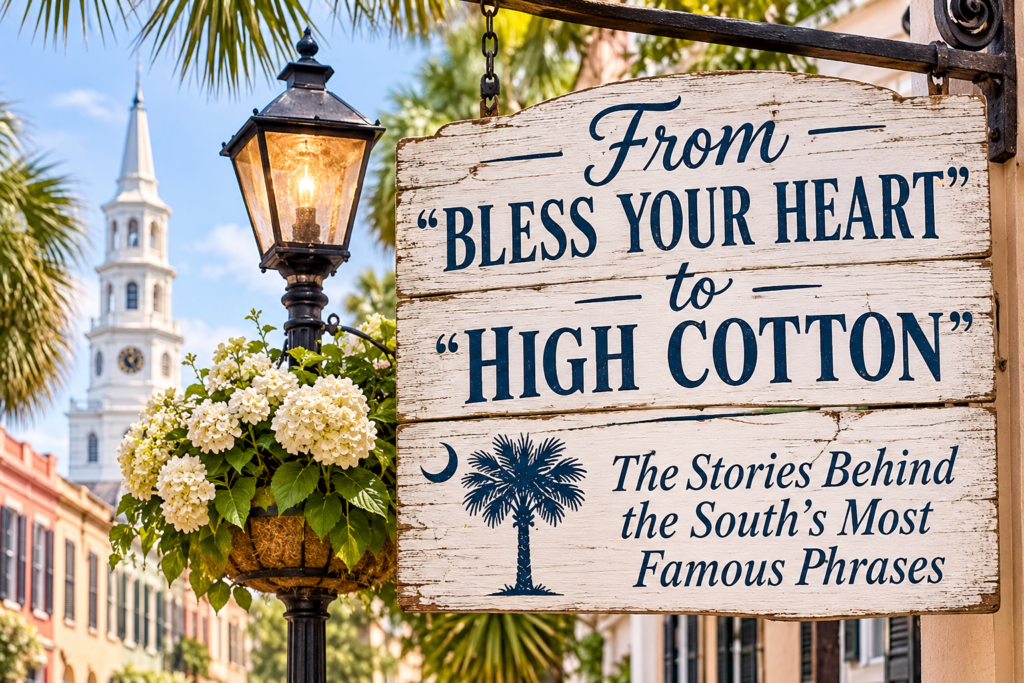
In Charleston, a conversation can begin with “How y’all doing?” move into a story about somebody being “in high cotton,” and end with a cheerful “If the good Lord’s willing and the creek don’t rise.”
To a visitor, it might sound like another language. To a Southerner, it is perfectly understandable.
Southern expressions are more than colorful combinations of words. Many are rooted in agriculture, hunting, religion, rural living and generations of oral storytelling. Some have been passed down through families for centuries, while others have evolved into expressions that now reach far beyond the Mason-Dixon Line.
But where did these famous phrases actually come from?
Let’s take a look at the history behind some of the South’s most recognizable sayings.
1. “Y’all” — A Little Word With a Long History
Few words are more closely associated with Southern identity than “y’all.”
A contraction of “you all,” the expression provides something English has historically lacked: an easy, conversational way to address more than one person.
Although its precise linguistic development has been debated, written examples of the Southern form date to the 19th century. A particularly interesting example appeared in an 1886 newspaper article discussing South Carolina expressions, which actually poked fun at the word.
Today, “y’all” has escaped its regional boundaries. It has become a popular, inclusive expression throughout the country.
And honestly, it’s a lot easier than saying “you guys.”
2. “Bless Your Heart” — Southern Kindness or a Polite Insult?
Perhaps no Southern expression has been more misunderstood, misinterpreted or enthusiastically adopted by outsiders.
“Bless your heart” has roots in religious language and the tradition of offering blessings, sympathy and goodwill to others.
But somewhere along the way, the expression developed another personality.
Depending on the circumstances, it can communicate genuine compassion or a subtle acknowledgment that someone has made a rather unfortunate decision.
Linguistic research published in the journal American Speech in 2020 examined the expression and found that its meaning is far more complicated than its popular reputation as a polite Southern insult suggests.
The secret is context.
If someone tells you about a difficult experience and responds with “Bless your heart,” they may genuinely mean it.
If you just made a spectacularly bad decision and hear those same three words, you might want to reconsider your choices.
3. “Fixin’ To” — Something Is About to Happen
“I’m fixin’ to leave.”
“I’m fixin’ to cook supper.”
“We’re fixin’ to have ourselves a good time.”
For Southerners, “fixin’ to” means preparing or intending to do something in the immediate future.
The expression has a fascinating linguistic history. Researchers have traced its development to the English verb “fix,” which evolved over centuries from meaning to make or arrange something into a regional expression indicating that an action is about to happen.
A 2014 study published in American Speech examined how “fixin’ to” developed into what linguists call a quasi-modal expression.
In other words, it isn’t simply bad grammar. It is a recognized and distinctive feature of Southern American English.
And if somebody tells you they’re fixin’ to do something, you can generally expect it to happen. Eventually.
4. “In High Cotton” — When Life Is Going Pretty Well
If somebody tells you they’re living in high cotton, consider it good news.
The expression means being prosperous, comfortable or enjoying a particularly fortunate period in life.
Its agricultural connection comes from the days when cotton was one of the South’s most important crops.
Cotton plants with abundant, higher-growing bolls could make picking easier because workers didn’t have to bend as far. The expression eventually became associated with favorable circumstances and prosperity.
Cotton shaped much of the Southern economy, although its history is inseparable from the forced labor of enslaved people whose exploitation made the plantation system possible.
Today, being “in high cotton” simply means things are going your way.
In Charleston, we’d probably say life is pretty sweet.
5. “That Dog Won’t Hunt” — A Southern Way of Saying No
You don’t need to own a hunting dog to understand this one.
“That dog won’t hunt” means an idea, excuse, explanation or proposal simply isn’t going to work.
The expression comes from the practical world of hunting, where a dog that refuses or fails to pursue game isn’t doing the job it was trained to do.
Interestingly, the phrase has a documented American history stretching back to the 19th century. An 1843 newspaper reference used the expression while discussing presidential politics.
It has since become a familiar Southern way of rejecting an idea without spending an entire afternoon explaining why.
For example:
“That business plan sounds good, but that dog won’t hunt.”
Translation: Start over.
6. “If the Good Lord’s Willing and the Creek Don’t Rise”
This might be one of the most beloved expressions in the South.
It generally means that something will happen as planned, provided nothing unexpected gets in the way.
The expression has a practical history. In rural communities, swollen creeks and rivers could make roads and crossings impassable, particularly before modern bridges and infrastructure.
There is also a popular story claiming that the phrase originated with Benjamin Hawkins, an American Indian agent who supposedly referred to the Creek Nation when discussing whether he could travel.
However, historians and language researchers have found no reliable documentary evidence supporting that story.
The earliest known printed version dates to 1851 and refers to a creek as a body of water.
Sometimes the simplest explanation really is the right one.
7. “Over Yonder” — Directions Without GPS
Before smartphones, navigation apps and satellite-guided directions, people often relied on landmarks, familiarity and a little local knowledge.
Enter “over yonder.”
The expression describes a location somewhere nearby or within sight, although its exact distance is left entirely to interpretation.
It could mean across the road, beyond the big oak tree or somewhere down the street.
The beauty of the expression is that it doesn’t require an address.
Of course, the person receiving the directions is expected to understand the local geography.
And if they don’t, well, that’s their problem.
8. “Come Hell or High Water” — A Promise of Determination
This expression means that something will get done regardless of the obstacles.
Its imagery is particularly fitting for the South, where floods, hurricanes, severe weather and difficult conditions have shaped communities for generations.
Although the phrase is not exclusively Southern, its language reflects a familiar regional experience: the determination to keep moving forward even when circumstances are working against you.
Whether it’s getting the family together, making it to Sunday dinner or opening a new business, some things are worth doing come hell or high water.
9. “Don’t Be Ugly” — It Has Nothing to Do With Your Appearance
In much of the country, ugly describes something unpleasant to look at.
In the South, however, telling someone not to be ugly has an entirely different meaning.
It is a reminder to behave, show some manners and treat other people with kindness.
A child being disrespectful might hear it from a grandparent. An adult behaving badly might hear it from a friend.
It is a remarkably efficient way of saying, “You know better than that.”
And in a region where hospitality and manners have long been important cultural values, the expression carries a little extra weight.
10. “Too Big for Your Britches” — Don’t Get Above Yourself
This expression is used to describe someone who has become overly confident, arrogant or convinced of their own importance.
Its imagery is wonderfully straightforward: someone wearing britches that are too big for them.
The phrase has been part of American English since the 19th century and reflects an older tradition of using clothing as a metaphor for someone’s social position or behavior.
It is essentially a reminder not to let success, money or a little attention go to your head.
In other words, remember where you came from.
The South Has a Language All Its Own
Southern expressions survive because they accomplish something that ordinary conversation sometimes cannot.
They communicate humor, affection, frustration, wisdom and even criticism without requiring a lengthy explanation.
They are part of the stories told around dinner tables, the conversations between neighbors, the advice handed down by grandparents and the everyday interactions that make Southern communities feel familiar.
Here in Charleston, where history and tradition are woven into everyday life, language is another part of the region’s character.
You might hear it in a downtown restaurant, on a neighborhood porch, at a family gathering or while talking with someone you’ve just met.
And perhaps that’s the real beauty of Southern expressions. They remind us that language isn’t simply about what we say. It’s about where we come from, who taught us and the communities that shaped us.
So the next time somebody asks how y’all are doing, just smile and tell them you’re doing pretty well.
And if somebody happens to ask whether you’re in high cotton?
Well, bless your heart. We certainly hope so.
Stay connected and subscribe to Charleston Daily.
