What’s New on the Charleston Peninsula This Fall (2026)


The peninsula in August feels like a held breath. The heat still has the last word most afternoons, the college students are trickling back, and the good tables at Bertha’s are still open on a Tuesday. Then something shifts. By late September the calendar tightens, a run of openings that spent the spring in soft-launch mode finds its footing, and the peninsula starts behaving like the version of itself locals actually prefer. This year the map is worth relearning. The most interesting new addresses have quietly clustered north of Broad, and the fall event calendar concentrates almost everything worth planning around into a six-week window between the last weekend of September and mid-November.

If you live here, you can spend the season chasing tourists to the same three streets, or you can read the shift and build your weekends around it. This post is for the second group.

The North-Of-Broad Rearrangement

The peninsula’s newest food is not opening on East Bay. It is opening on Mary, on Cannon, on Concord, and along the harborside blocks the guide books still describe as “quiet.”

PopUp Bagels, the national bagel shop known for freshly baked bagels and rotating schmears, is opening at 83 Mary Street, which puts a legitimate morning bagel inside walking distance of NoMo and the upper Elliotborough blocks that never had one. A few streets over on Cannon, Alteño is slated to open in summer 2026 at 89 Cannon Street, on the ground floor of The Charlee on Cannon, as a second location for the Mexican concept from Fonda Fina Hospitality founders Johnny and Kasie Curiel. If you have eaten at Fonda Fina, you already know whether this matters to you.

Bareo, a Filipino-Japanese concept from local restaurateurs focused on dumplings and kakigori, and The Crossing, a coastal Mediterranean restaurant that is part of The Cooper at 176 Concord Street, round out the shortlist of new openings that have real cooking behind them rather than just a good build-out. And Babas, inspired by the neighborhood cafés of Italy, France and Spain, serving house-made pastries and espresso in the morning, sandwiches and salads at lunch, and cocktails and wine in the evening, opened January 2026. It is the kind of all-day café the peninsula has been asking for and rarely getting.

Coffee has its own new anchor. Harlow and Pearl started as a coffee trailer and is now set up in the lobby of the rehabbed 1960s Starlight Motor Inn, which is the sort of sentence you either understand immediately or need to see in person. The drinks are extravagant. The room is the point.

The Cooper Is A Real Change To The Waterfront

Charleston’s relationship with its own waterfront has always been slightly strange. We built a city around a harbor and then spent 200 years mostly eating inland from it. For a city blessed with so many fabulous seafood restaurants, Charleston has surprisingly few true waterfront dining options, and the opening of The Cooper in the French Quarter offers new opportunities, featuring sweeping harbor vistas throughout the property; its signature restaurant, The Crossing, serves sophisticated Eastern Mediterranean fare. On the same property, CurrentBurger runs as a nostalgic soda-shop style burger joint with smash burgers and shakes, and Cooper Coffee & Wine works as a café by day and a wine bar by night overlooking the marina.

Three concepts on one property, one of them with an actual harbor view, all of them within a five-minute walk of the Dock Street Theatre. If you have friends coming in for a weekend this fall and you were tired of the East Bay rotation, this is the answer.

Hotel Restaurants, Reconsidered

Hotel restaurants on the peninsula have historically been treated as places you eat when the concierge won’t let you leave. Two are worth breaking the habit for this fall.

At the Mills House, Iron Rose Bar & Restaurant at 115 Meeting Street has appointed Suzy Castelloe as executive chef, features a seasonally driven take on Southern coastal cuisine, and Castelloe brings experience from acclaimed restaurants including Charleston Grill and Coda Del Pesce. The Charleston Grill résumé alone earns a first visit. At Live Oak, the Modern Mediterranean cuisine at Terra draws from the flavors, foragers, farms and fisheries of the Lowcountry, along with recipes inspired by the sunny coasts that touch the Mediterranean from all four directions. Both rooms are the sort of place that stays quietly bookable in October while the rest of the peninsula is chasing Spoleto tables in the spring.

Six Weeks That Set The Season

Here is the calendar the peninsula actually runs on this fall. Print it, screenshot it, whatever you do with useful lists.

  • September 24 through October 4: MOJA Arts Festival, an annual festival of Black arts and culture, with a wide range of visual and performing arts events at venues across Charleston.
  • October 24: Charleston Beer Fest in Riverfront Park, North Charleston, with craft beers, live music, food, games and more. Off-peninsula, worth the drive.
  • November 6 through 15: Charleston Literary Festival at the Dock Street Theatre, with talks with a wide range of fiction and nonfiction authors plus other events. This is the most peninsula-shaped event on the list, and Dock Street is a short walk from The Cooper.
  • November 7: Harvest Festival at Johns Island County Park, with bluegrass music, pumpkin decorating, southern food, craft market, and hayrides.
  • November 14: Holy Smokes: A Lowcountry Barbecue Festival at Riverfront Park, North Charleston, featuring regional BBQ styles from 50-plus pitmasters and chefs, live music and more.
  • November 22: Heritage Fire, an annual food festival at The Refinery featuring local chefs.

The density is the story. Six anchor events in eight weeks. If you plan even three of them, your fall is planned.

Pairing The Openings With The Dates

The map and the calendar reward being read together. A few pairings that work if you plan them a week ahead.

Charleston Literary Festival + The Cooper. Dock Street Theatre sits inside the same French Quarter pocket as The Cooper. A pre-talk drink at Cooper Coffee & Wine and a walk to Dock Street is the version of a Charleston literary evening that doesn’t require a car. Resy’s own guide notes that if you’re catching a show at the Dock Street Theater, Sorelle, Blind Tiger pub, and G&M Fast and French are natural neighbors, which is worth knowing if The Crossing is booked.

MOJA weekends + upper peninsula breakfast. MOJA’s venues stretch across the city, but many of the daytime programs sit north of Calhoun. Start the morning at Babas or at PopUp Bagels once it opens, and walk into the day from there.

A slow Saturday, no event. On the second Sunday of each month from 1 to 5pm, King Street is closed to all vehicular traffic to celebrate the shopping, dining and services the region has to offer. The peninsula’s own quiet ritual, still underused by residents. Pair it with a first look at Harlow and Pearl at the Starlight Motor Inn and you have the sort of afternoon that reminds you why you live here.

Source: Oyster Point Real Estate Group

Stay connected and subscribe to Charleston Daily.

11 South Carolina Cities U.S. News Says Are Among the Best Places to Live in 2026

By Mark A. Leon

South Carolina has no shortage of places that can make a strong case for calling the Palmetto State home. From the Lowcountry coast to the Upstate, communities across the state continue to attract new residents with a combination of jobs, quality of life, outdoor recreation and Southern charm.

U.S. News & World Report’s 2025-2026 Best Places to Live rankings put 11 South Carolina communities on the list, with several of the state’s best-known cities joined by communities that are becoming increasingly popular with people looking to relocate.

At the top is Mount Pleasant, followed by Greenville and FlorenceCharleston comes in at No. 4, while Rock Hillrounds out the top five.

The 11 best places to live in South Carolina

  1. Mount Pleasant — Coastal living, highly regarded schools, restaurants, shopping and easy access to Charleston and area beaches make Mount Pleasant a standout for families and professionals.
  2. Greenville — A booming Upstate economy, revitalized downtown, Falls Park and access to the Blue Ridge Mountains give Greenville an unusually strong mix of jobs, culture and outdoor recreation. U.S. News also ranked Greenville No. 4 nationally among the best places to live.
  3. Florence — Affordability is a major draw. The Pee Dee city combines a growing economy, healthcare and retail opportunities, schools and a convenient location roughly an hour from the coast.
  4. Charleston — The Holy City remains one of South Carolina’s most recognizable destinations, but its appeal goes beyond tourism. Residents have access to a strong job market, restaurants, beaches, history and cultural attractions. U.S. News highlighted Charleston’s job market, food, entertainment and beach access, while noting that housing costs remain a challenge.
  5. Rock Hill — Located about 25 miles south of Charlotte, Rock Hill offers residents access to a major metropolitan job market while maintaining a more affordable lifestyle. Its growing downtown, proximity to Lake Wylie and relatively short commute add to its appeal.
  6. Columbia — South Carolina’s capital benefits from its universities, healthcare sector, government jobs, growing downtown and access to Lake Murray. The city also offers a lower cost of living than the state’s most expensive coastal markets.
  7. Summerville — The rapidly growing Charleston-area community continues to attract families looking for more space and a suburban lifestyle while remaining within reach of the Lowcountry’s jobs, beaches and attractions.
  8. Spartanburg — Manufacturing, healthcare, education and a revitalizing downtown give Spartanburg a strong economic foundation, while its Upstate location puts residents within easy reach of Greenville and the mountains.
  9. Myrtle Beach — For those who want the beach to be part of everyday life, Myrtle Beach offers miles of shoreline, entertainment, restaurants, golf and an expanding residential community beyond the traditional tourist areas.
  10. Hilton Head Island — With 12 miles of beaches, extensive bike paths, golf and a relaxed coastal lifestyle, Hilton Head remains one of the state’s premier places for people seeking a higher-end Lowcountry lifestyle.
  11. Bluffton — Just minutes from Hilton Head, Bluffton combines Old Town charm, waterfront scenery, golf, restaurants and a rapidly growing residential community. It has become one of the Lowcountry’s most sought-after alternatives to island living.

Greenville, SC

What stands out about the U.S. News list is the variety. South Carolina’s appeal isn’t tied to one particular lifestyle. Someone looking for beaches can choose Hilton Head or Myrtle Beach. A family may favor Mount Pleasant, Rock Hill or Summerville. Career-focused residents have Greenville, Columbia and Charleston, while Florence and Spartanburg offer a different balance of affordability and opportunity.

The rankings also underscore a larger trend: South Carolina continues to attract people who want a combination of economic opportunity, outdoor access and a relatively manageable cost of living.

And while Charleston may not take the No. 1 spot this time, its presence near the top is hardly a surprise. The Holy City continues to offer something few places can replicate — a historic coastal setting paired with a modern economy, nationally recognized food scene and unmistakable Lowcountry character.

For anyone considering a move in 2026, the U.S. News list makes one thing clear: there is no single “best” South Carolina city. The better question may be which version of South Carolina fits you best.

Stay connected and subscribe to Charleston Daily.
Florence, SC

Cooper River Bridge – Joining Charleston and Mount Pleasant

Charleston Landmark Silver Dollar to Close After 26 Years on King Street

By Mark A Leon

One of downtown Charleston’s most recognizable neighborhood bars is preparing to pour its last drink. Silver Dollar, a longtime King Street fixture, announced it will close its doors on Sunday, Aug. 23, ending a 26-year run in the heart of the city.

Since opening in 1999, the beloved watering hole has earned a loyal following among locals, hospitality workers, musicians, and visitors looking for an unpretentious place to gather. Known for its laid-back atmosphere and strong sense of community, Silver Dollar became a staple of Charleston’s nightlife during a period of dramatic change and growth on the peninsula.

The closure marks the end of an era for many Charlestonians who have celebrated milestones, forged friendships, and created lasting memories within its walls. As news of the closing spreads, patrons have taken to social media to share stories and express gratitude for a bar that remained a constant amid a rapidly evolving King Street corridor.

Silver Dollar’s final day of operation is scheduled for Sunday, Aug. 23, giving longtime customers one last opportunity to raise a glass to a Charleston institution.

Stay connected and subscribe to Charleston Daily.

Photo Credit: Silver Dollar Charleston

Smoke, Fire, and a New Chapter: Truth BBQ Sets Its Sights on Charleston

By Mark A Leon

Charleston’s barbecue scene is about to get a little hotter.

The nationally acclaimed Truth BBQ is expanding to Charleston, with plans to open at the former Rutledge Cab Company site on Upper King Street. The highly anticipated addition brings one of Texas’ most celebrated barbecue brands to the heart of one of America’s most celebrated food cities.

Founded by pitmaster Leonard Botello IV, Truth BBQ has earned national recognition for its Central Texas-style barbecue, including perfectly smoked brisket, house-made sausages, pork ribs, and scratch-made sides. The restaurant has become a destination for barbecue lovers from across the country and has received Michelin Guide recognition for its commitment to quality and craftsmanship.

The choice of the former Rutledge Cab Company property is fitting. The expansive location offers room for the kind of large-scale operation that Truth BBQ is known for while placing it in one of Charleston’s fastest-growing culinary corridors. The area has become a magnet for innovative restaurants, breweries, and hospitality concepts, making it a natural home for the Texas barbecue powerhouse.

For Charleston diners, the opening represents more than just another restaurant. It signals the continued evolution of the city’s food scene, which has attracted acclaimed chefs and nationally recognized brands eager to be part of the Lowcountry’s culinary culture. While Charleston already boasts an impressive roster of barbecue destinations, Truth BBQ brings a distinctly Texas perspective that will add even more depth and variety to the local landscape.

The arrival of Truth BBQ is expected to draw locals and visitors alike, with many already anticipating the long lines and sold-out trays that have become part of the restaurant’s reputation in Texas. From brisket with a pepper-crusted bark to smoked meats cooked low and slow for hours, the experience promises to be worth the wait.

As Charleston continues to grow as a national dining destination, the addition of Truth BBQ at the former Rutledge Cab Company site is poised to become one of the city’s most talked-about restaurant openings. For barbecue lovers, the truth is simple: Charleston just landed a major player.

Stay connected and subscribe to Charleston Daily.

Photo Credit: Truth BBQ

Clemson University researcher part of NASA mission to better understand atmospheric waves and space weather

By Cindy Landrum

Space weather can disrupt technologies people rely on every day, like GPS navigation, satellite communications and spacecraft operations.

Space weather can disrupt technologies people rely on every day, like GPS navigation, satellite communications and spacecraft operations. 

Clemson University associate professor Xian Lu is a co-investigator on NASA’s DAPHNE (Dynamic Atmosphere-Ionosphere Explorer) mission that will study how changes in Earth’s lower atmosphere influence our planet’s upper atmosphere, where space weather is manifested.

NASA has chosen the mission to enter Phase B of development, which includes planning and design for flight and mission operations.

headshot of Xian Lu
Xian Lu

“Space weather is often influenced not only by the sun, but also by disturbances that originate in Earth’s lower atmosphere and travel upward,” Lu said. “DAPHNE will help us better understand how these atmospheric processes interact with energy from space to shape the near-Earth environment.”

Led by Aimee Merkel from the Laboratory for Atmospheric and Space Physics at the University of Colorado Boulder, DAPHNE will use two identical satellites that will provide coordinated, multi-point measurements of neutral winds, temperature and composition in the ionosphere and thermosphere. The ionosphere and thermosphere are the regions where Earth’s neutral atmosphere transitions into the ionized plasma of space. 

Clemson’s role in the mission comes through Lu’s work of combining observations and numerical models to study how atmospheric waves from the lower atmosphere interact with energy coming from space to shape Earth’s upper atmosphere and ionosphere. For DAPHNE, modeling will help scientists interpret satellite data, test whether the models accurately represent the physical system and improve the ability to predict space weather.

NASA said DAPHNE will undergo a confirmation review in 2027 to assess mission progress and funding availability. If confirmed, the mission launch date will be no earlier than 2029.

The DAPHNE mission was proposed as a concept study in response to NASA’s DYNAMIC (Dynamical Neutral Atmosphere-Ionosphere Coupling) mission announcement of opportunity. 

Source: Clemson University

Image credit: LASP/Mary Tostanoski

Stay connected and subscribe to Charleston Daily.
University of South Carolina donors power a record-shattering year of giving with $357.6M

By Jeff Stensland, stenslan@mailbox.sc.edu,

The University of South Carolina system raised a record $357.6 million in private support during fiscal year 2026 — the most in its history, shattering the previous fundraising record of $259.7 million, set just one year earlier, by nearly $100 million.

In addition, nearly 48,600 individual donors gave to the university this year, including more than 16,000 who were supporting USC for the first time. This demonstrated an unprecedented level of participation from alumni, families and friends who believe in Carolina.

This momentum was on full display during Give 4 Garnet, the university’s annual day of giving, when more than 7,200 donors came together to support scholarships, academic programs, athletics, student organizations and initiatives across every USC campus. The day highlighted the breadth of philanthropy across USC and the many ways donors are investing in its future.

“This historic year reflects great confidence in the mission of the University of South Carolina,” USC President Michael Amiridis said. “Our alumni, friends and partners are investing in the people, ideas and discoveries that will shape USC’s future. Their generosity is expanding opportunity, accelerating innovation and strengthening our impact across South Carolina and beyond.”

A highlight of the university’s record-breaking year came in May, when a $30 million gift named the Kay and C. Edward Floyd, M.D. School of Medicine — a milestone for health sciences at USC. A separate $22 million anonymous gift to the medical school will strengthen research, scholarships and hands-on clinical training.

Among the year’s largest commitments was a $25 million gift from the Robert and Janice McNair Foundation, extending one of the most enduring philanthropic partnerships in the university’s history. Robert C. McNair, a 1958 USC graduate and founder of the Houston Texans, and his wife, Janice, established the McNair Scholars program in 1998, drawing many of the nation’s most accomplished students to the South Carolina Honors College.

The gift carries added significance this year. Janice McNair passed away in July at age 89. Together, she and Bob gave more than half a billion dollars during their lifetimes to causes they believed in and left an enduring legacy of generosity at Carolina that will continue to shape generations of scholars and leaders.

Donor support remained strong across every area of the university during fiscal year 2026. The university secured approximately $129 million for academic support and $81 million in athletics donations, supporting scholarships to student-athletes and program enhancements across all Gamecock sports. In addition, $147 million was raised for Williams-Brice Reimagined, a transformational stadium renovation initiative to enhance the fan environment, expand premium seating opportunities and strengthen resources for student-athletes.

Transformational impact across colleges and campuses

FY26 brought landmark gifts to units across the university. Highlights include:

  • The College of Hospitality, Retail and Sport Management named the new David and Nicole Tepper Department of Sport and Entertainment Management.
  • USC Beaufort named the Jonathan Green Maritime Cultural Center, celebrating the Lowcountry’s rich cultural heritage.
  • The Molinaroli College of Engineering and Computing received a $7 million planned gift to support future engineers and computer scientists.
  • The School of Music secured one of the largest gifts in its history to endow a chair in Baroque and early music.
  • The College of Pharmacy received $2.5 million to advance pediatric oncology research.

Investing in students and the future  

At its core, this year’s giving came back to students — opening doors, easing the cost of a degree and expanding what’s possible at Carolina:

  • More than $80 million directed to student aid and scholarships, expanding access and affordability for students across the state
  • 108 gifts of $1 million or more — among the most in a single year in university history
  • Nearly $50 million in planned gifts, securing a lasting foundation for generations of future students

“This year proved what’s possible when thousands of people rally behind a shared vision for Carolina,” USC’s Vice President for Development Michelle Dodenhoff said. “From first-time donors to transformational philanthropists, every gift moved the university forward. That collective generosity is strengthening every college, every campus and every student we serve. People want to be part of what’s happening at Carolina — and that momentum is only growing.”

Source: University of South Carolina

Stay connected and subscribe to Charleston Daily.
Steris to invest $600 million, add 335 jobs in Sanford, North Carolina

Mentor, Ohio-based life sciences company Steris plans to invest $600 million to create 335 jobs over the next four years at a new manufacturing and distribution center in Sanford.

A Department of Commerce committee awarded Steris a potential economic grant of $3.2 million over 12 years if Steris hits the investment and job creation targets. The city of Sanford and Lee County will contribute an additional $18.1 million in incentives.

Founded in 1985 by microbiologist Raymond Kralovic, Steris makes sterilization products for the healthcare sector with an emphasis on preventing infections. It now employs more than 18,000 people at 250 locations in around 40 countries. About 11,000 of its employees are based in the U.S. Steris employs 186 workers in the state in other divisions.

The new jobs will pay an average annual salary of $68,704, almost 15% higher than Lee County’s current average wage of $59,903. North Carolina’s average wage is $70,672.

Steris plans to build a 600,000-square-foot building and produce cleaning and sterilization solutions. Its product line includes endoscopy accessories, surgical tables and connectivity solutions for operating rooms.

The expansion will increase capacity, accelerate innovation and strengthen its distribution network, says CEO Dan Carestio. Sanford is about 40 miles southwest of Raleigh.

The $600 million investment includes $16 million for land, $327 million for construction and $257 million for equipment and personal property. The project is expected to be completed by the end of 2030. Hiring could begin in 2027 or 2028. Steris also considered a site in Minnesota, near where it has operations, but opted for North Carolina.

The announcement comes as another drug manufacturrer Pfizer, has scaled back its plans in Sanford, where it employs about 1,500 workers. Last year, it ended an economic development deal with the state that would have added 300 jobs in the county. In 2024, Pfizer laid off 150 workers in Lee County.

Source: Business NC

Stay connected and subscribe to Charleston Daily.

The Other Side of Paradise: 15 Reasons the Charleston Lowcountry May Not Be the Right Place to Move To

For decades, Charleston has been marketed as a Southern dream. Travel magazines celebrate its historic streets, award-winning restaurants, pristine beaches, and easygoing coastal lifestyle. Thousands of newcomers arrive every year chasing visions of sunset walks along the harbor and weekends spent on the water.

Yet life in the Lowcountry isn’t always as idyllic as the brochures suggest.

Charleston remains one of America’s most beautiful places, but beauty often comes with trade-offs. Before making the move, it’s worth considering the challenges many longtime residents face every day.

1. Traffic Has Become a Daily Frustration

Ask longtime residents what has changed the most over the past twenty years and many will give the same answer: traffic.

Major corridors such as I-26, Highway 17, Savannah Highway, Main Road, and Clements Ferry Road routinely experience congestion that can turn short trips into lengthy commutes. Population growth has dramatically increased the number of vehicles on roads that were never designed for today’s demand. (charlestonhousingnews.com⁠)

2. Infrastructure Is Struggling to Keep Up

Roads, bridges, drainage systems, schools, and utilities have all been strained by rapid growth. Critics argue that development has often outpaced infrastructure investments, creating bottlenecks throughout the region. (Historic Charleston Foundation⁠)

3. Housing Costs Have Skyrocketed

The days of Charleston being an affordable coastal city are largely gone.

Home prices have risen dramatically over the past decade, making homeownership increasingly difficult for many working families. Some neighborhoods that were once attainable are now priced beyond the reach of teachers, firefighters, hospitality workers, and young professionals. (Charleston SC⁠)

4. Rent Isn’t Much Better

Even renters are feeling the squeeze. Apartment rents have climbed steadily throughout the region, forcing many residents farther from the peninsula and major employment centers. The result is often a longer commute and higher transportation costs. (Reddit⁠)

5. Local Wages Often Don’t Match Living Costs

Charleston’s economy is fueled by tourism, hospitality, retail, and service industries. While the region has added higher-paying jobs in manufacturing and technology, many residents still find local wages lagging behind housing and living expenses. City housing analyses have identified the mismatch between wages and housing costs as a major challenge. (Charleston SC⁠)

6. Flooding Is a Reality

Charleston’s geography is both its greatest asset and one of its biggest vulnerabilities.

Heavy rain, king tides, and storm surges can leave roads underwater, even outside of hurricane season. In some areas, flooding has become a regular inconvenience rather than a rare event. (The Wall Street Journal⁠)

7. Hurricane Season Brings Annual Anxiety

Living on the coast means living with the possibility of tropical storms and hurricanes. Evacuation plans, emergency supplies, and weather monitoring become part of everyday life from June through November.

8. Insurance Costs Continue to Rise

Flood insurance, wind coverage, and homeowners insurance can add significant expenses to an already costly housing market. Coastal living often comes with premiums that surprise newcomers.

9. The Humidity Can Be Brutal

Charleston summers aren’t simply hot—they’re intensely humid.

From June through September, stepping outside can feel like walking into a steam room. Temperatures in the 90s combined with high humidity frequently push heat indexes well above 100 degrees.

10. Mosquitoes Love the Lowcountry

Marshes, tidal creeks, ponds, and wetlands create ideal breeding grounds for mosquitoes. Outdoor gatherings often require bug spray, citronella candles, or strategic timing.

11. Palmetto Bugs Are Practically Residents

Newcomers quickly learn that “palmetto bug” is often a more polite name for a very large flying cockroach.

Even immaculate homes encounter them from time to time. It’s simply part of living in a warm, humid coastal environment.

12. Tourist Season Never Really Ends

Millions of visitors come to Charleston every year. While tourism fuels the economy, it also means crowded sidewalks, packed restaurants, limited parking, and long waits during peak seasons.

For residents, navigating downtown can sometimes feel like living in a permanent vacation destination.

13. Public Transportation Is Limited

Unlike larger metropolitan areas, Charleston offers few alternatives to driving. Most residents rely heavily on personal vehicles, making traffic congestion even more pronounced.

14. Commutes Keep Getting Longer

As housing becomes more expensive closer to downtown, many workers have moved to Summerville, Moncks Corner, Goose Creek, and other outer communities. That affordability often comes at the cost of spending hours each week in traffic. (charlestonhousingnews.com⁠)

15. The Character of the Region Is Changing

Growth brings opportunity, but it also changes communities.

Many longtime residents worry that the Lowcountry’s historic charm, local culture, and slower pace are being replaced by sprawling development and increasing congestion. The debate over growth versus preservation has become one of the defining issues facing the region.

Paradise With Fine Print

None of this means Charleston isn’t a wonderful place to live. For many people, the beaches, history, food, natural beauty, and year-round outdoor lifestyle easily outweigh the drawbacks.

But moving to the Lowcountry should be a decision based on reality, not postcards.

Charleston can be magical. It can also be expensive, crowded, humid, flood-prone, and frustratingly congested.

The truth is that the Charleston Lowcountry isn’t for everyone—and knowing that before you move may be the smartest relocation decision you make.

Stay connected and subscribe to Charleston Daily.

Photo Credit: Charleston Daily.

Emily Westenberger: Fashion, Storytelling & the Art of Elegance

By Mark A Leon

In a city known for its beauty, Charleston artist Emily Westenberger brings a distinctly feminine and sophisticated voice to the local art scene. Blending the worlds of fashion design, illustration, and collage, her work feels as if it has drifted from the pages of a Parisian fashion journal and landed gently in the Lowcountry.

Westenberger’s illustrations are instantly recognizable. Delicate line work forms elegant female figures while layers of vintage-inspired papers, fabrics, photographs, and textures create garments that seem to carry stories of their own. The result is artwork that feels both modern and nostalgic—equal parts couture sketch, personal diary, and dreamscape.

Before establishing herself in Charleston, Westenberger spent seven years working as a fashion designer in Los Angeles. That experience continues to shape her artistic vision, bringing an understanding of silhouette, movement, and craftsmanship that elevates each piece beyond traditional illustration.

Her latest collection, The Stories We Wear, explores the idea that clothing is far more than fabric. Every garment carries memories, aspirations, travels, and moments that become part of our personal narrative. Through layered collage and soft washes of color, Westenberger transforms those stories into visual poetry.

The works featured here showcase that unique approach. One figure emerges from a gown assembled from fragments of photographs and handwritten notes. Another gazes confidently from a pastel backdrop, her form built from collected memories and architectural details. Elsewhere, a stylish woman strolls with her dog beneath a frame of flowers, while a pink-toned portrait combines fashion imagery and personal symbolism into a striking contemporary statement.

What makes Westenberger’s work so compelling is its balance of refinement and emotion. Her illustrations celebrate beauty, but they also invite viewers to look deeper—beyond the fashion and into the stories hidden within each layer.

In addition to her gallery work, Westenberger creates custom illustrations and live fashion sketches for events, capturing the style and personality of her subjects with the same graceful touch found throughout her collection.

For collectors seeking artwork that is elegant, imaginative, and deeply personal, Emily Westenberger offers a refreshing perspective—one where fashion becomes fine art and every image tells a story.

Follow Emily’s work on Instagram at @emilywestenberger⁠ and explore her collections at Emily Westenberger Studio⁠.

Stay connected and subscribe to Charleston Daily.
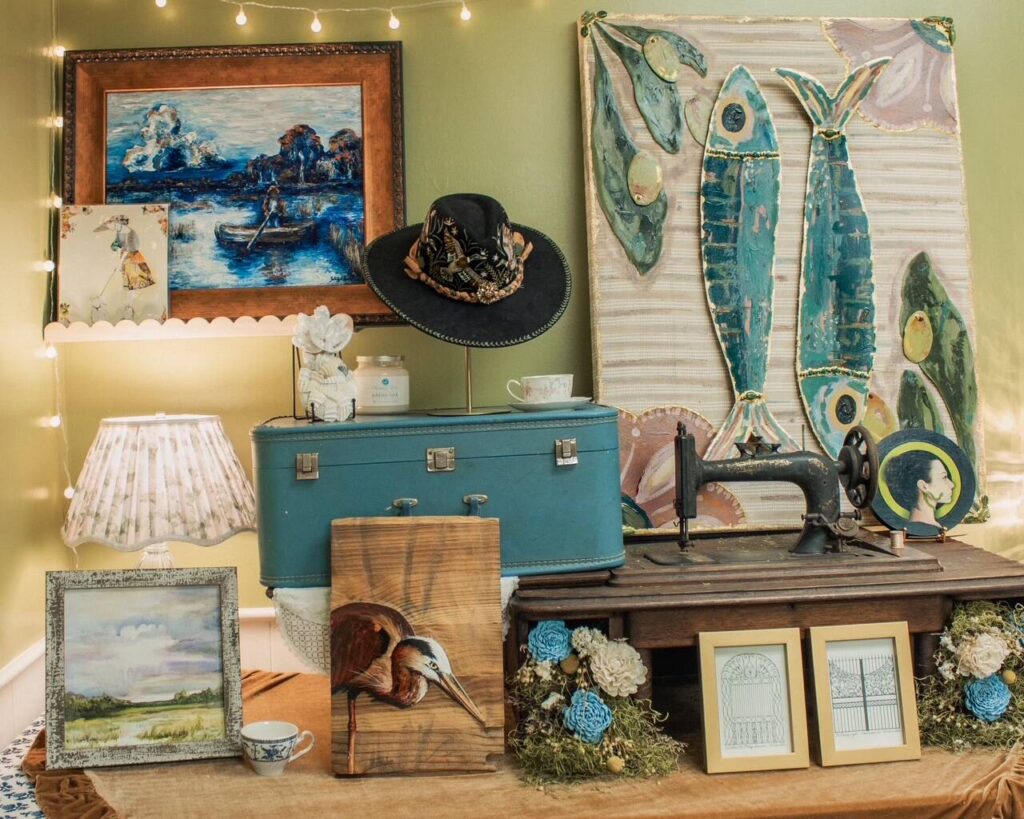
Photo credit: Emily Westenberger


4 Quiet Escapes Just Minutes Outside Charleston, SC Where You Can Breathe Again

By Mark A. Leon

Charleston is known for its bustling restaurants, lively beaches, and historic streets filled with visitors. But just beyond the city’s busiest corners are peaceful places where the soundtrack changes from traffic and conversations to marsh grass swaying in the breeze, birds calling overhead, and water gently moving with the tide.

Whether you need an afternoon to recharge, a place to cast a fishing line, or simply somewhere to clear your head, these Lowcountry escapes offer the perfect reset—without requiring a long drive.

1. Find Solitude at Caw Caw Interpretive Center

About 20 minutes from downtown Charleston, Caw Caw Interpretive Center feels worlds away from city life. Once a colonial-era rice plantation, the preserve now features more than six miles of trails winding through freshwater wetlands, cypress swamps, open fields, and historic rice impoundments.

Bring binoculars and you’ll likely spot great blue herons, bald eagles, turtles, and perhaps even an alligator sunning itself along the water’s edge. The quiet here is striking, making it one of the best places in the Lowcountry to reconnect with nature and slow your pace.

Early mornings are especially magical as mist rises from the marsh and wildlife becomes most active.

2. Watch the Harbor Wake Up at Mount Pleasant Pier

There’s something calming about standing over Charleston Harbor before the crowds arrive. Mount Pleasant Pier stretches more than 1,200 feet into the water beneath the Arthur Ravenel Jr. Bridge, providing panoramic views of downtown Charleston, passing shrimp boats, dolphins, and sailboats.

Even if fishing isn’t your hobby, the pier invites visitors to simply sit on one of its benches and let the harbor do the talking. Sunrise and sunset transform the skyline into one of the most peaceful scenes in the region.

It’s a favorite among locals because it never feels rushed, despite being only minutes from downtown.

3. Discover Charleston’s Quietest Waterfront at Stono River County Park

Hidden on Johns Island, Stono River County Park remains one of Charleston County’s best-kept secrets. Elevated boardwalks stretch through marshes before opening onto a long fishing and crabbing dock overlooking the Stono River.

Unlike many waterfront parks, you’ll often find yourself sharing the scenery with only a handful of people. Bring a fishing rod, pack lunch, or simply enjoy watching dolphins occasionally surface in the river as boats quietly drift by.

The peaceful atmosphere has made it a favorite recommendation among Charleston residents looking for a true nature escape.

Mount Pleasant Memorial Waterfront Park

4. Enjoy Dinner with a View at MOMO Riverfront Park

Sometimes escaping doesn’t require hiking boots—it just takes the right patio.

MOMO Riverfront Park in North Charleston overlooks the Cooper River from one of the area’s most tranquil waterfront settings. Located beside Riverfront Park, the restaurant combines elevated comfort food with sweeping river views, making it an ideal place to unwind after work or enjoy a quiet evening.

Grab a table outside, order a cocktail, and watch cargo ships slowly glide toward Charleston Harbor as the sun sets behind the trees. After dinner, take a leisurely stroll through Riverfront Park, where wide green spaces and waterfront paths offer a peaceful finish to the evening.

Sometimes the Best Destination Is Peace

Charleston’s greatest luxury isn’t always found inside a five-star hotel or behind a reservation list. Sometimes it’s standing quietly on a fishing pier before sunrise, walking a shaded trail with only birds for company, or watching the tide roll in from a secluded dock.

The next time life feels hectic, skip the crowds. Within 30 minutes of downtown, these hidden corners of the Lowcountry remind us that peace isn’t far away—you simply have to know where to look.

Stay connected and subscribe to Charleston Daily.

MOMO Riverfront Park