 by
By Mark A Leon – Charleston Daily
From Pat Conroy’s love affair with the Lowcountry to the observations of writers, visitors and historical figures, Charleston has a way of inspiring words that stay with us.
Some cities are difficult to describe. Charleston is one of them.
You can talk about the pastel-colored homes, church steeples, centuries-old cobblestone streets, live oaks draped in Spanish moss and salty breezes coming off the harbor. You can describe the restaurants, gardens, historic neighborhoods and waterfront sunsets.
But somehow, words never seem quite enough.
Perhaps that’s why Charleston has inspired generations of writers, poets, historians and storytellers. It is a city that invites reflection, rewards curiosity and leaves an impression long after someone has departed.
Few captured that feeling more beautifully than the late Pat Conroy, whose writing often read like a personal love letter to the Carolina Lowcountry.
Here are 10 memorable quotes and literary reflections that capture Charleston, its character and the unmistakable feeling of being here.
1. Pat Conroy — The Mansion on the River
“It was my father who called the city the Mansion on the River.”
Reference: Pat Conroy, South of Broad (2009).
Perhaps no literary description better captures the emotional connection between Charleston and those who call it home. In South of Broad, Conroy devotes an extraordinary passage to his father’s love of Charleston and his own lifelong attachment to the peninsula.
He writes about the Ashley and Cooper rivers, Colonial Lake, the bells of St. Michael’s, the gardens, architecture, seafood and culinary traditions that define the city.
One particularly memorable line describes Charleston as a place “so pretty it makes your eyes ache with pleasure.”
Conroy’s reflection reminds us that Charleston’s greatest treasures aren’t simply its historic buildings or waterfront views. They are the memories, traditions and generations of people who give the city its soul.
2. Pat Conroy — The Atmosphere of Charleston
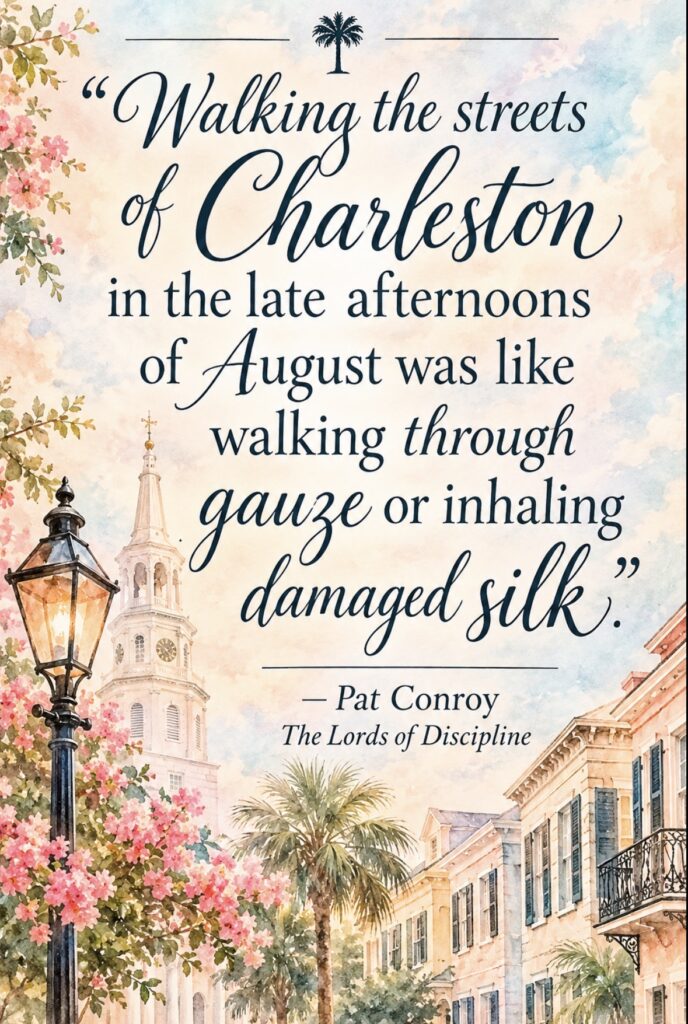
“Walking the streets of Charleston in the late afternoons of August was like walking through gauze or inhaling damaged silk.”
Reference: Pat Conroy, The Lords of Discipline (1980).
Anyone who has walked downtown on a humid August afternoon understands this description. Conroy had a remarkable ability to turn the heat, humidity and atmosphere of Charleston into something almost tangible.
3. Pat Conroy — A City Unlike Anywhere Else
“There is no city on Earth quite like Charleston.”
Reference: Attributed to Pat Conroy in collections of Charleston quotations; exact original publication not independently established.
Sometimes the simplest words carry the greatest meaning. For Conroy, Charleston was a lifelong source of inspiration, beauty and complicated affection.
4. Marquis de Lafayette — An Early Appreciation
“Charleston is one of the best built, handsomest, and most agreeable cities that I have ever seen.”
Reference: Marquis de Lafayette, correspondence associated with his 1825 visit to Charleston.
The French military officer and American Revolutionary War hero visited Charleston and left with a glowing impression. Nearly two centuries later, his observation still resonates.
5. Anne Rivers Siddons — Finding a Sense of Home
“I live in one now, Charleston.”
Reference: Anne Rivers Siddons, CNN interview, Author Anne Rivers Siddons on her book Nora, Nora, August 1, 2000.
Siddons, a celebrated Southern novelist, spoke about the charm and individuality of the city she called home. Her words capture something many residents understand: Charleston isn’t simply somewhere you live; it’s somewhere you belong.
6. Josephine Pinckney — Charleston’s Conversational Traditions
“People think we don’t talk about anything else in Charleston.”
Reference: Josephine Pinckney, Three O’Clock Dinner, University of South Carolina Press.
A wonderful bit of Charleston humor from a Charleston-born novelist. In a city where family names, generations and history often find their way into everyday conversation, Pinckney’s observation remains delightfully recognizable.
7. Rhett Butler — Returning to Where You Belong
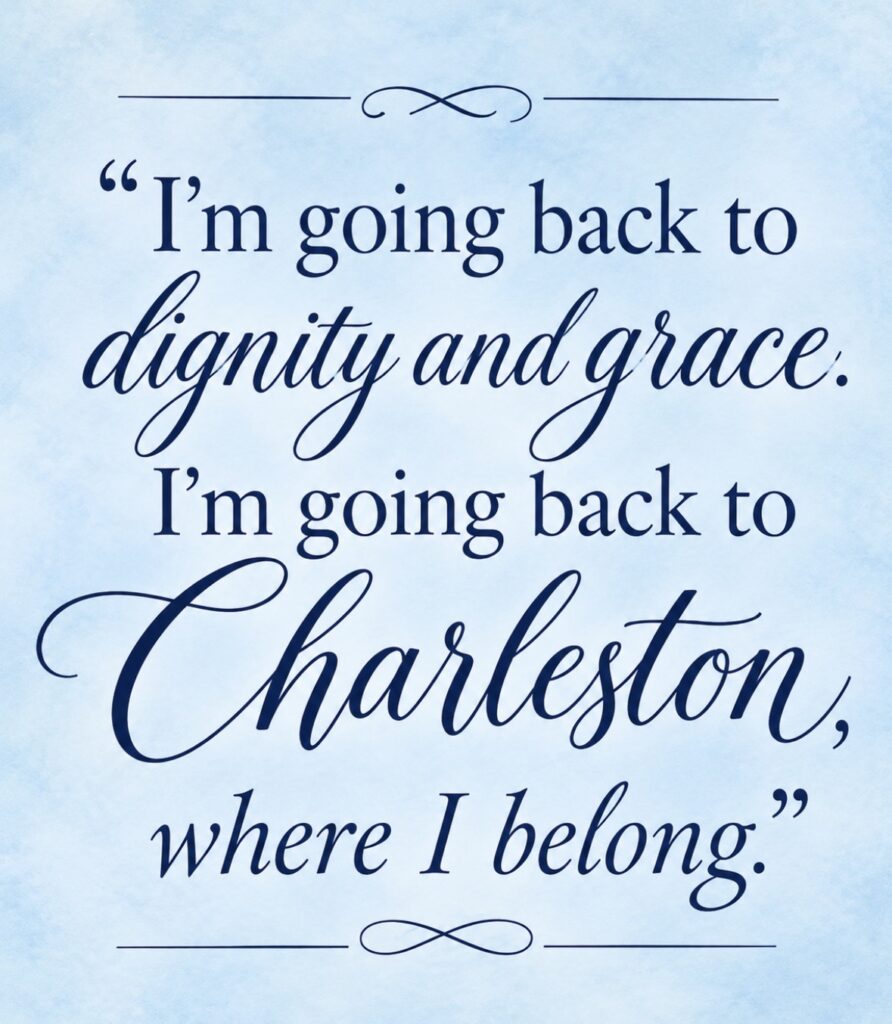
“I’m going back to dignity and grace. I’m going back to Charleston, where I belong.”
Reference: Rhett Butler, as portrayed in Margaret Mitchell’s Gone with the Wind (1936).
Although Rhett Butler is a fictional character, the sentiment captures an enduring Southern romanticism: the idea that no matter how far life takes you, there is something special about returning home.
8. Thomas Gibson — Appreciating Charleston
“Charleston is an amazing place. I probably didn’t appreciate it enough when I was growing up.”
Reference: Thomas Gibson, actor and Charleston native; quotation featured in Charleston Daily’s collection of memorable Charleston quotations.
Sometimes it takes leaving a place to recognize what made it special. Gibson’s observation is one many Charleston natives and former residents can appreciate.
9. Pat Conroy — The Stories Behind the Streets
“Charleston is a city of stories, and every street has a memory.”
Reference: Original editorial reflection inspired by the themes of Pat Conroy’s South of Broad (2009), not a direct quotation.
Conroy’s sweeping novel is a portrait of friendship, family, love, loss and life in Charleston. Through its historic streets and familiar neighborhoods, the story reminds us that the city’s greatest treasures are often the generations of people and relationships that give its streets meaning.
10. Mark R. Jones — A City Built on History
“Welcome to Charleston, an English colony founded in 1670.”
Reference: Mark R. Jones, quotation featured in Charleston Daily’s collection of memorable Charleston quotations.
A reminder that beneath the beauty and romance lies a history stretching back more than three and a half centuries. Charleston’s story is written into its streets, architecture, harbor and neighborhoods.
Bonus
“It was my father who called the city the Mansion on the River. He was talking about Charleston, South Carolina, and he was a native son, peacock proud of a town so pretty it makes your eyes ache with pleasure just to walk down its spellbinding, narrow streets. Charleston was my father’s ministry, his hobbyhorse, his quiet obsession, and the great love of his life. His bloodstream lit up my own with a passion for the city that I’ve never lost nor ever will. I’m Charleston-born, and bred. The city’s two rivers, the Ashley and the Cooper, have flooded and shaped all the days of my life on this storied peninsula. I carry the delicate porcelain beauty of Charleston like the hinged shell of some soft-tissued mollusk. My soul is peninsula-shaped and sun-hardened and river-swollen. The high tides of the city flood my consciousness each day, subject to the whims and harmonies of full moons rising out of the Atlantic. I grow calm when I see the ranks of palmetto trees pulling guard duty on the banks of Colonial Lake or hear the bells of St. Michael’s calling cadence in the cicada-filled trees along Meeting Street. Deep in my bones, I knew early that I was one of those incorrigible creatures known as Charlestonians. It comes to me as a surprising form of knowledge that my time in the city is more vocation than gift; it is my destiny, not my choice. I consider it a high privilege to be a native of one of the loveliest American cities, not a high-kicking, glossy, or lipsticked city, not a city with bells on its fingers or brightly painted toenails, but a ruffled, low-slung city, understated and tolerant of nothing mismade or ostentatious. Though Charleston feels a seersuckered, tuxedoed view of itself, it approves of restraint far more than vainglory. As a boy, in my own backyard I could catch a basket of blue crabs, a string of flounder, a dozen redfish, or a net full of white shrimp. All this I could do in a city enchanting enough to charm cobras out of baskets, one so corniced and filigreed and elaborate that it leaves strangers awed and natives self-satisfied. In its shadows you can find metalwork as delicate as lace and spiral staircases as elaborate as yachts. In the secrecy of its gardens you can discover jasmine and camellias and hundreds of other plants that look embroidered and stolen from the Garden of Eden for the sheer love of richness and the joy of stealing from the gods. In its kitchens, the stoves are lit up in happiness as the lamb is marinating in red wine sauce, vinaigrette is prepared for the salad, crabmeat is anointed with sherry, custards are baked in the oven, and buttermilk biscuits cool on the counter.”
― Pat Conroy, South of Broad
The Last Word: Charleston Is More Than a Place
There is a reason people write about Charleston. There is a reason photographers return to the same streets, artists continually find new inspiration in its colors and visitors often leave promising to return.
Charleston has a personality all its own.
It can be elegant and eccentric, welcoming and complicated, historic and wonderfully contemporary. It is a city of contrasts, where centuries-old traditions meet new ideas, and where beauty can be discovered in an elaborate iron gate, a quiet churchyard or an ordinary walk along the Battery.
Perhaps Pat Conroy’s South of Broad captures the feeling better than almost anything else. His description of Charleston as the Mansion on the River is more than a literary flourish. It is an expression of belonging, identity and an enduring love affair with a remarkable place.
Some cities you visit. Some cities you remember. And then there’s Charleston — the city that finds a way to become part of you.
Charleston Daily | Celebrating the people, places, history and stories that make the Lowcountry extraordinary
Stay connected and subscribe to Charleston Daily
