 by
By Mark A Leon
From a multibillion-dollar flood protection plan to airport access, roadway improvements and wastewater upgrades, the Lowcountry is investing in infrastructure to keep pace with growth. Here’s where the major projects stand.
Charleston’s infrastructure landscape is changing, with public agencies advancing projects designed to reduce flooding, improve traffic flow, modernize wastewater treatment and create safer connections between communities.
The projects vary widely in scale and schedule. Some are approaching completion, others remain in design or permitting, and several of the region’s largest transportation investments will take years to deliver.
Here is a look at six significant projects, their estimated costs, funding sources and current status.
1. The Battery Extension: A multibillion-dollar defense against flooding
Estimated cost: $1.3 billion originally authorized for the full project; approximately $613.2 million for the initial segments under 2026 estimates.
Funding: 65% federal funding through the U.S. Army Corps of Engineers and 35% local funding, subject to the project’s cost-sharing arrangements.
Status: Engineering and design are underway.
One of Charleston’s most consequential infrastructure projects aims to protect the historic peninsula from storm surge and coastal flooding. The Battery Extension would expand the city’s existing waterfront defenses, combining flood barriers with public spaces and pedestrian promenades.
In September, the Army Corps awarded more than $6.2 million in engineering and design contracts covering two sections, including Adger’s Wharf and the Lockwood Drive waterfront. These contracts represent early design work, not the cost of constructing the entire system.
The city’s 2026 estimates put the initial segments at approximately $613.2 million. That estimate excludes several potential expenses, including aesthetic enhancements, utility relocation and certain environmental mitigation costs.
The project remains in its pre-construction engineering and design phase. Its ultimate price and schedule will depend on design decisions, funding and construction sequencing.
Sources: City of Charleston | Live 5 News
2. Airport Connector Road: A new route to Charleston International Airport
Estimated funding: $205 million in Charleston County’s FY2025 capital improvement plan.
Funding: Charleston County Transportation Sales Tax program.
Status: Right-of-way acquisition and permitting; construction has not yet begun.
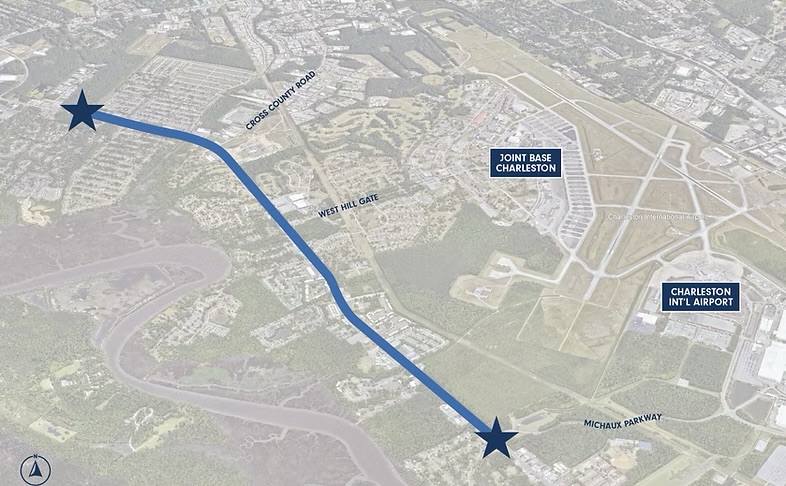
The Airport Connector Road project is intended to create more direct access to Charleston International Airport and improve connections between Dorchester Road, Montague Avenue and I-526.
The goal is to separate airport traffic from other commuter movements in an area experiencing continued residential, commercial and employment growth.
In June 2026, county officials said land acquisition was approximately 50% complete. The project must also complete the necessary permitting before moving into construction.
The federal permitting dashboard lists environmental review and permitting as ongoing, with an estimated completion date of June 30, 2027. That is a permitting milestone, not a guaranteed opening date for the road.
The county’s FY2025 capital plan listed $205 million in funding and an expected completion year of 2027. Given the later permitting timeline, residents should watch for updated construction and completion schedules.
Sources: Charleston County Transportation Development | Federal Permitting Dashboard | Live 5 News
3. Main Road Corridor: A long-term investment in Johns Island and West Ashley
Estimated funding: $407 million for the broader Main Road Corridor program in the county’s FY2025 capital plan.
Funding: Charleston County Transportation Sales Tax program.
Status: Construction and phased improvements are progressing, with additional work continuing over multiple years.
Main Road is a critical route for residents traveling through Johns Island and West Ashley. The county’s corridor program includes intersection improvements, roadway widening and connections intended to accommodate growth and improve traffic movement.
Segment A includes improvements at the U.S. 17 and Main Road intersection and along Main Road between Bees Ferry Road and River Road. Other segments address additional portions of the corridor.
The county’s published capital plan listed an expected 2029 completion for Segment A, while Segment C was listed for 2027. Individual schedules may change as engineering, construction and right-of-way requirements evolve.
The project is supported through the county’s transportation sales tax program, with funding allocated across a broader portfolio of road investments.
Sources: Charleston County Transportation Development | Charleston County FY2025 Capital Improvement Plan
4. Ashley River Bicycle and Pedestrian Bridge: Connecting downtown and West Ashley
Additional funding approved in 2026: $437,500.
Total project cost: A current, verified total was not established in the available updates.
Funding: A federal BUILD grant, alongside local funding and other project allocations.
Status: Construction is underway; opening is targeted for fall 2027.
The Ashley River Bicycle and Pedestrian Bridge is designed to provide a safer way to cross the river between downtown Charleston and West Ashley without relying on existing bridges that prohibit bicycle and pedestrian travel.
The project will connect the West Ashley Greenway with the peninsula’s pedestrian network. Construction began in January 2025.
A July 2026 update from Charleston Moves reported that construction was approximately two-thirds complete and the movable span was being installed. The eastern landing design, including connections to the Medical District and Brittlebank Park, remained an important issue for city officials.
In February, Charleston City Council approved an additional $437,500 for design work and a contract adjustment associated with unexpected site conditions.
The bridge represents a different kind of infrastructure investment: rather than adding vehicle capacity, it creates a dedicated connection for people walking and cycling.
Sources: Charleston Moves | City of Charleston Projects
5. Plum Island Wastewater Treatment Plant: $115 million in upgrades
Reported investment: $115 million in plant improvements.
Funding: Charleston Water System capital improvement funding; the specific funding breakdown for these improvements was not established in the available report.
Status: Multiple upgrades are at different stages of operation and implementation.
Charleston’s growth requires investments below ground as well as on its roads. Charleston Water System is undertaking $115 million in improvements at the Plum Island Wastewater Treatment Plant to support operations, capacity and long-term reliability.
The upgrades include a new primary clarifier, a solids-dewatering process and a disinfection facility. The clarifier was already online by March 2026, while the solids building was expected to become operational during summer 2026.
The improvements are intended to help the plant manage wastewater volumes and maintain treatment performance as the region grows.
Charleston Water System’s broader 2024–2027 capital improvement program also includes projects to replace aging infrastructure, expand service capacity and address regulatory requirements.
Sources: Charleston Water System Capital Program | Live 5 News
6. Palmetto Commerce Interchange: A major project completed ahead of schedule
Reported project cost: Approximately $90 million in projected funding; the county reported a construction cost of $60.4 million.
Funding: Charleston County Transportation Sales Tax program.
Status: Substantially complete and opened in November 2025; remaining landscaping work was scheduled for 2026.
The Palmetto Commerce Interchange was designed to improve access between I-26, U.S. 78 and the growing Palmetto Commerce Parkway area in North Charleston.
The project opened in November 2025, ahead of its original February 2026 completion target. County leaders said it was completed under budget, leaving funding available for other transportation priorities.
The new interchange is intended to improve traffic flow, provide additional access options and support the area’s expanding employment and commercial development.
Although the main construction project is complete, associated landscaping and tree replacement work continued into 2026.
Sources: Charleston County Transportation Sales Tax Program | Live 5 News
What comes next?
Charleston County is also developing its next Transportation Sales Tax program, with a proposed long-term investment framework covering roadways, public transit, bicycle and pedestrian improvements, and green space.
In February 2026, county officials discussed a draft program projected to generate approximately $4.25 billion over 25 years. The proposal has since gone through additional review and public outreach. Proposed allocations and project lists should not be confused with money already spent or construction contracts already awarded.
For residents, the takeaway is that Charleston’s infrastructure needs extend well beyond any single road project. Flood protection, wastewater treatment, airport access and safe transportation connections are all part of the region’s response to growth and environmental challenges.
The coming years will test whether these investments can keep pace with development while protecting the Lowcountry’s historic communities, neighborhoods and quality of life.
Charleston Daily will continue tracking project costs, funding decisions, construction milestones and schedule changes as these major investments move forward.
Stay connected and subscribe to Charleston Daily.
