by
by 
By Mark A Leon
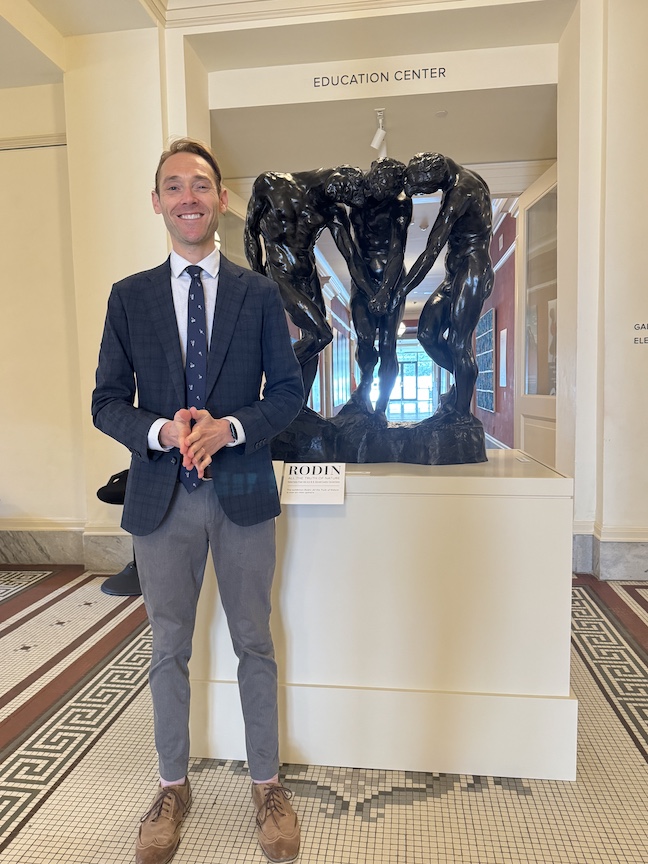
Dr. Alex Rich arrived at the Gibbes Museum of Art with a clear mission: to honor the institution’s long Southern legacy while broadening its appeal and educational reach. In his first year as President and CEO, Rich has already moved decisively to put that vision into practice, and his inaugural project—a focused exhibition of Auguste Rodin sculptures—serves as a useful lens on his leadership style, curatorial priorities, and plans for growth.
A scholar who describes himself as “the professor” at heart, Rich came to museum work from an academic background and a strong belief in public-facing education. He told us that stepping away from a tenure-track role and into the museum world was driven by a desire to make art both “educational and fun.” That dual orientation—rigorous scholarship paired with broad accessibility—has shaped every major decision he’s made since arriving in Charleston. Rich’s early months were marked by rapid immersion into the Gibbes’ history and collection; during his finalist interview he had his first visit to the museum, and that initial encounter sparked the Rodin idea: “One of the first things I thought was a Rodin would look really great right there in the transept,” he said, imagining a powerful silhouette greeting visitors as they entered.
The Rodin exhibition is notable for its fast turnaround and for how it leverages relationships to accelerate institutional ambitions. Rich drew on a prior long-term loan relationship with the Cantor Foundation from his previous museum position to bring the sculptures to the Gibbes. He described the project’s intent succinctly: Rodin functions as an immediate, recognizable draw—“you walk into a museum, you see Rodin sculptures, and you know that you are in a great museum”—while also acting as a bridge to the museum’s regional strengths. The exhibition’s layout reflects this thinking. Rather than forcing a single path, Rich and his team designed multiple entry points—three Shades on the ground floor paired with a larger upstairs presentation—so visitors can start anywhere and still receive a layered, coherent narrative. “You really can start anywhere,” he explained, noting that the curatorial texts are tailored for each room to create distinct but complementary experiences.
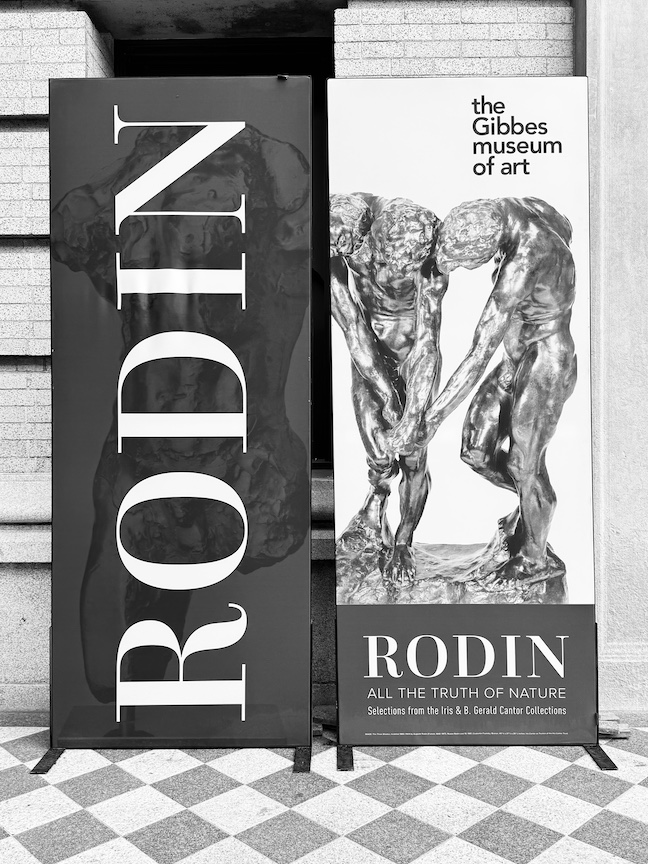
Rich’s leadership philosophy is grounded in five pillars he uses to describe the Gibbes: scholarly, educational, unique, aspirational and accessible. These words are not aspirational slogans alone; they inform programming choices and institutional priorities. The museum’s regional identity—its 170-year focus on American art told through a Southern lens—will remain central, Rich emphasized, even as the institution seeks a broader national profile. The challenge, he said, is “thread[ing] that needle finely”—holding on to the Gibbes’ particular mission while expanding its scope so it can be counted among the nation’s great art museums.
Community engagement and accessibility are core to Rich’s agenda. He wants the museum to be both a rigorous center for scholarship and a welcoming public space. He repeatedly framed the museum as a place for many kinds of encounters: refuge, education, and delight. “Everything we do has to meet two expectations. It has to be educational and it has to be fun,” he told us, a mantra that informs programming from family events to lectures and community workshops. That commitment is visible in current and recent initiatives—from community-created scroll installations to innovative pop-up events—designed to break down barriers and counteract the elitist tropes sometimes associated with museums.
The Rodin exhibition also illustrates Rich’s curatorial intent to use canonical work as an invitation to local discovery. By pairing Rodin with works by Charleston artists such as Leo Twiggs, the museum aims to convert the initial draw of a famous name into sustained engagement with local and regional art. “Visitors attracted by Rodin may leave having discovered Charleston artists,” Rich said, underlining the museum’s strategy to make every major show a portal to its permanent collection.
Looking ahead, the Gibbes’ expansion is perhaps the clearest indicator of Rich’s long-term priorities. A new wing scheduled to open in about a year will add more than 6,000 square feet to the museum’s footprint, including roughly 3,000 square feet of flexible galleries and a dedicated Center for Education on the ground floor. Rich stressed that the expansion is not merely about square footage; it’s a strategic investment in the museum’s educational mission and its capacity to serve a growing, diverse audience. The new ground floor education center will include multiple classrooms, dedicated early-childhood learning space, and areas for K–12 and adult programming—an explicit rebuttal to the trend of shrinking museum education departments. As Rich noted, the Gibbes was founded on education in 1858, and the expansion is a recommitment to that founding ideal.
For Rich, travel and study of other institutions inform innovation at home. He shared how recent visits, such as to the Zeitz Museum of Contemporary African Art, offered insights on spatial flexibility and multi-entry exhibition strategies that resonated with the Gibbes’ own curatorial experiments. That openness to learning—combined with an ability to marshal relationships, act quickly, and center education—defines his early tenure.
In short, Dr. Alex Rich’s first year at the Gibbes has been about aligning legacy with ambition. By staging a high‑visibility Rodin installation, articulating clear institutional pillars, and advancing a significant expansion that places education at the center, he has signaled a roadmap for the museum: maintain its Southern identity, welcome a broad public, and build the infrastructure to educate generations to come. As he put it, museums should be places where people both “recharge and refresh”—and under his leadership, the Gibbes is positioning itself to be precisely that kind of place for Charleston and beyond.
Stay connected and subscribe to Charleston Daily.