 by
by 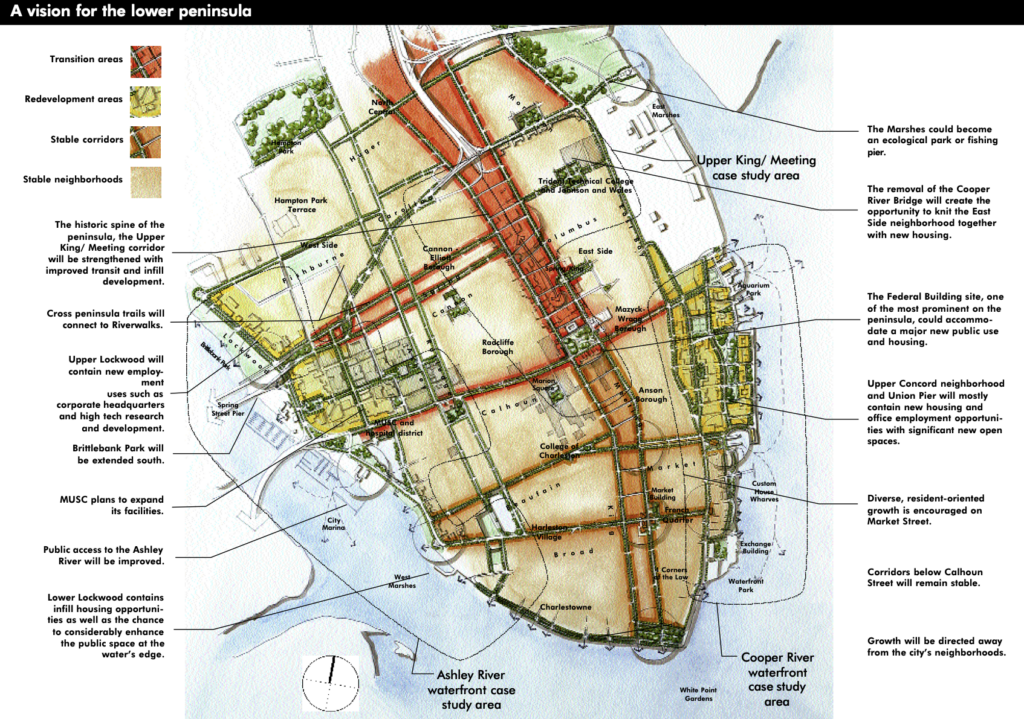
By Mark A. Leon
The Charleston Peninsula Plan is the City’s new long-range vision for managing growth on the peninsula over the coming decades. It replaces and expands upon the 1999 Downtown Plan by addressing modern challenges such as housing affordability, climate resilience, mobility, economic development, and equitable growth. The planning process began in 2023 and is expected to culminate with City Council adoption following the release of a draft plan.
Let us take a look and breakdown the current plan that was published in 1999:
The 1999 Charleston Downtown Plan: Achieving Balance Through Strategic Growth, adopted by Charleston City Council in November 1999, was the city’s first comprehensive master plan focused exclusively on the downtown peninsula. Developed with input from more than 1,600 residents, business owners, institutions, and stakeholders, the plan sought to address growing development pressures while preserving the character and livability that make Charleston unique.
Click HERE for original document.
Why the Plan Was Created
By the late 1990s, Charleston’s historic peninsula was experiencing rapid growth driven by:
- A booming tourism industry
- Expanding colleges and medical institutions
- Increased residential demand
- Economic revitalization and private investment
- Limited available land for new development
While these trends strengthened the city’s economy, they also created concerns about traffic congestion, housing affordability, neighborhood preservation, and quality of life. Rather than choosing between preservation and growth, the plan argued that both could coexist if growth was carefully managed.
Central Philosophy
The plan’s guiding premise was simple:
Growth is inevitable. The challenge is directing it to improve the city rather than diminish it.
Instead of stopping development, Charleston should strategically guide where and how new investment occurs to benefit residents, businesses, and visitors alike.
Nine Guiding Principles
The Downtown Plan established nine principles that continue to influence planning today:
- Nurture inclusive, vibrant neighborhoods
- Protect established residential communities.
- Encourage mixed-income housing.
- Maintain neighborhood identity.
- Pursue economic diversity
- Support a balanced economy beyond tourism.
- Encourage office employment, retail, cultural institutions, and neighborhood-serving businesses.
- Foster sustainability
- Promote environmentally responsible development.
- Preserve natural resources.
- Encourage efficient land use.
- Reinforce the existing urban structure
- Build upon Charleston’s traditional street grid.
- Promote walkability and connected neighborhoods.
- Respect the grain, scale, and mix of the peninsula’s urban fabric
- Ensure new development fits existing block patterns.
- Avoid oversized buildings incompatible with historic neighborhoods.
- Ensure architectural integrity
- Require high-quality architecture that complements Charleston’s historic character.
- Strengthen urban design standards.
- Encourage a balanced transportation network
- Improve pedestrian, bicycle, transit, and automobile circulation.
- Reduce dependence on cars where possible.
- Use growth strategically
- Direct higher-density development toward areas capable of accommodating it.
- Protect the most sensitive historic neighborhoods.
- Maintain downtown as the regional center of culture and commerce
- Preserve Charleston’s role as the Lowcountry’s economic, governmental, educational, and cultural hub.
Strategic Growth Areas
One of the plan’s most influential recommendations was to distinguish where growth should occur.
South of Calhoun Street
The plan recommended:
- Limited new development
- Strong historic preservation
- Protection of established neighborhoods
- Maintaining the area’s traditional scale and character
North of Calhoun Street
The plan encouraged:
- Greater redevelopment opportunities
- Mixed-use development
- Higher-density housing
- Office and employment growth
- Reinvestment in underutilized properties
This framework recognized that concentrating growth in appropriate locations could relieve pressure on Charleston’s most historic neighborhoods while stimulating investment where it was most needed.
Transportation Vision
The plan acknowledged that increasing automobile traffic threatened downtown quality of life and recommended:
- Better public transit
- Improved bicycle infrastructure
- Expanded pedestrian-friendly streets
- Parking management
- More connected street networks
- Reduced dependence on single-occupancy vehicles
Many of these ideas foreshadowed today’s emphasis on multimodal transportation.
Housing Goals
The Downtown Plan sought to:
- Expand housing opportunities for different income levels.
- Preserve residential neighborhoods.
- Encourage mixed-use development where appropriate.
- Maintain a stable year-round residential population.
The authors recognized that downtown should remain a place where people live—not simply a destination for tourists and commuters.
Waterfront Vision
The plan also envisioned significant changes along Charleston’s waterfront, recommending that as industrial uses declined, redevelopment should:
- Improve public waterfront access
- Extend Charleston’s traditional urban street pattern to the water
- Create parks and public spaces
- Encourage compatible mixed-use development
These concepts later influenced projects such as the redevelopment planning for Union Pier and other waterfront areas.
Public Participation
The planning process was unusually collaborative for its time. It included:
- More than 1,600 participants
- Neighborhood meetings
- Public workshops
- Open houses
- Farmers Market outreach
- Library exhibits
- Advisory committees representing residents, businesses, and institutions
City officials described it as a true community-driven vision for downtown Charleston.
Lasting Legacy
More than 25 years later, the 1999 Downtown Plan remains one of Charleston’s most influential planning documents. It has guided decisions on:
- Historic preservation
- Land use
- Urban design
- Transportation
- Waterfront redevelopment
- Housing policy
- Economic development
The City’s current Charleston Peninsula Plan is intended to build upon the 1999 framework while expanding its focus beyond the historic lower peninsula to include the Upper Peninsula and the Neck. Today’s update addresses newer challenges such as climate resilience, flooding, housing affordability, equitable growth, and modern transportation, while retaining many of the original plan’s core principles of balancing preservation with strategic growth.
Stay connected and subscribe to Charleston Daily.
